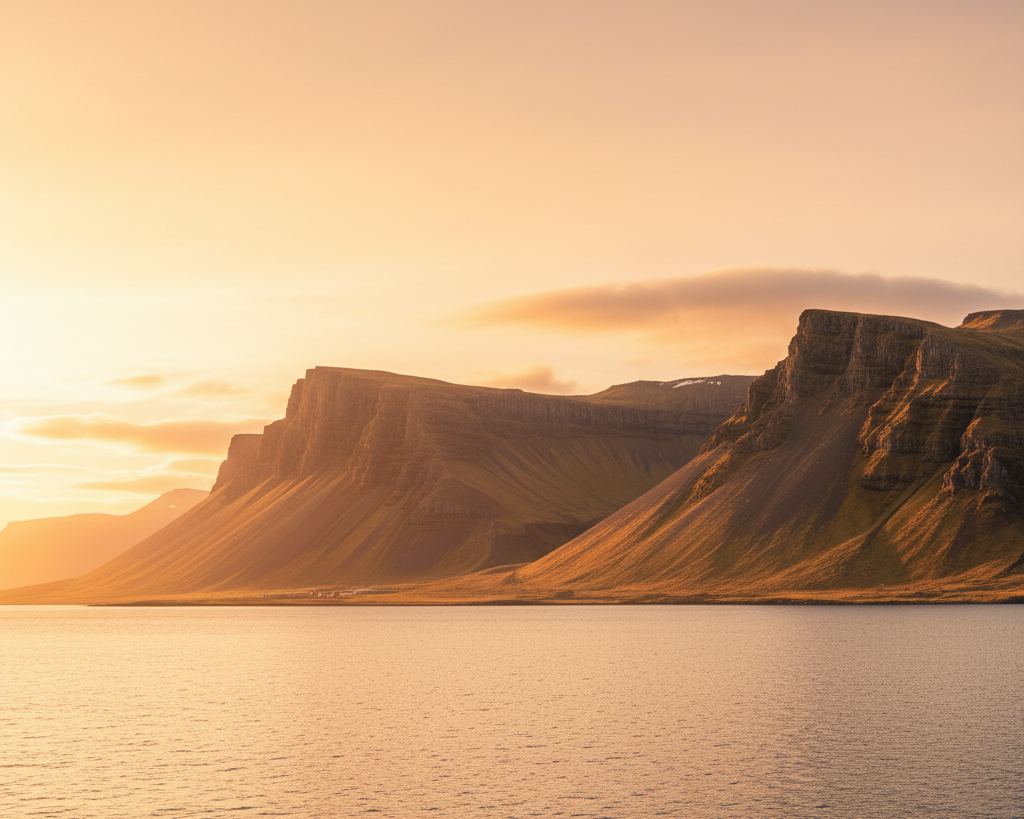
the sun on the water at half past one in the morning
Reserve a midnight sun trip in the Westfjords, June 6 to July 6
Eight nights on the northwest peninsula of Iceland, dated inside June 6 to July 6, from $6,474 per person on two sharing. The rooms, the vehicle and driver, the guide and the operator's crossing into the north coast reserve are held as one reservation. The eight days are arranged around a single hour, 01:00 to 02:00, when the sun bottoms out over the northern water and comes back up without going under it.
Reserve a windowAn answer is written inside one business day by somebody at this end.
The reason to book a midnight sun trip in the Westfjords rather than somewhere else in Iceland is latitude, and the number is small enough to be worth stating. The outer north coast of the peninsula sits at about 66.45 degrees north. The Arctic Circle is at 66.56. That leaves the coast roughly a tenth of a degree short of the line where the sun is supposed to stay up, and for a month either side of the solstice the shortfall is cancelled by refraction, because light bending through cold air over cold water lifts the whole disc back over the sea line. From about June 6 to about July 6, on that coast, the sun does not go under.
That is a different thing from a bright night, which the entire country gets from the middle of May onward. A bright night means you can read outdoors at two in the morning. This means the sun is still a disc, low and orange, travelling sideways along the northern water instead of down into it. At the latitude of the main town, 66.07, the bottom edge of the disc is cut by the horizon and the rest of it clears. Forty kilometers further north, out on the reserve coast, none of it is cut at all.
The hour is the other half of the arrangement. Iceland runs a single clock and does not shift it in summer, and that clock belongs to a meridian well east of where the country physically sits, so the sun is highest here at about 13:32 and lowest at about 01:33. Not midnight. Half past one. On every one of the eight nights the group leaves the rooms around 00:45 and is back before 02:15, and that hour is the reason the other twenty three are laid out the way they are.
Runs June 6 to July 6.
The sun stops setting on the outer north coast at about June 6 and starts setting again at about July 6, and the heath roads that reach that coast are normally clear of snow by the first of those dates.
The solar dates shift by less than a day between years while the snow on the passes and the first boat of the season shift by as much as two weeks, so this office fixes your departure at the time it books and moves it only if the pass or the landing is closed.
One hour. The trip is programmed for 01:00 to 02:00, because Iceland runs one clock that belongs to a meridian well east of the country itself, so the lowest sun of the night falls at about 01:33 rather than at midnight.
The rest of the day carries nothing compulsory: breakfast is still out at 11:00, the afternoon is a drive or a walk or sleep, and between 02:15 and 11:00 nothing at all is arranged.
8 nights, from $6,474 per person.
The position of the sun is arithmetic and does not vary, but cloud does, and on this coast you should plan on two or three of the eight nights being shut in with the sky bright and the disc invisible. Nature is not underwritten by anybody, and a grey horizon changes neither the itinerary nor the figure.
The reservation is eight nights on two sharing, five of them in a guesthouse above the harbour in the main town and three in a farmhouse on the western side, where nothing tall stands between the windows and due north.
- What this office books
- This office reserves the eight nights of rooms, the vehicle and driver, the guiding, and the operating company's crossing into the reserve as one booking with that company, and it does not sell, issue or hold any air ticket.
- Who books it
- A person booking this wants to stand on a headland at 01:33 with the northern horizon open and watch the lower edge of the sun touch the sea and lift off it again.
- Why somebody picks another window
- If you want the cliff birds at full strength, warmer water and heath roads that give no argument, the second half of July does all three, and by July 20 the sun is under the horizon for about three and a half hours a night.
- In the figure
- Eight nights of rooms on two sharing, five in a guesthouse above the harbour and three in a farmhouse with four rooms; breakfast every morning from 09:30 to 11:30; a nine seat vehicle with a driver who also guides; the operating company's crossing to the north coast reserve and back, held under that company's own licence; the landing permission the operating company carries for the reserve; every transfer between the airport and the guesthouse; the hour from 01:00 to 02:00 run on every night of the trip; loan of a windproof outer shell and rubber boots in sizes 36 to 47; one hot meal on each of the two reserve days; and written notes on where the northern horizon is open from each place you sleep.
- Not in the figure
- The round trip flight from Orlando, $780 to $1,410 in June, which is yours to arrange; lunches and dinners away from the two reserve days, $28 to $65 a person a day; beer or wine, $9 to $14 a glass; the swimming pool in town, about $8 a visit; a room to yourself instead of two sharing, $1,180 across the eight nights; laundry at the guesthouse, $18 a load; anything bought at the one grocery on the western side, budget $40 to $90 for the trip; a private vehicle for a day away from the group, $310 to $420; gratuities, which nobody asks for and nobody refuses; and the cost of moving your own flight if your dates change.
- Who this window will not suit
- Do not book this if you sleep badly in light, because the room is bright at 03:00, the blinds are thin, and an eye mask does not settle it for everybody. Do not book it if being awake from 00:45 to 02:15 every night wrecks the day that follows, since that is the entire shape of the trip. Do not book it if you need warmth: June here means 8 to 12 degrees C in the afternoon, wind off the water, and rain on some of the days. And do not book it if a clouded horizon would ruin the eight nights for you, because two or three of them usually are.
A starting figure for two people sharing one room. Pricing the exact window you pick runs two to four working days, because the company working those dates answers first. No air ticket is ever folded in.
The hour it is built around, and the rest of the day
The trip is programmed for 01:00 to 02:00 and for nothing else. There is no morning departure, no fixed afternoon and no evening meal anyone is expected at. Breakfast is still going at 11:00. The afternoon is a drive, a walk, or sleeping off the previous night, and most people do all three across eight days. If you want your days filled from waking, this is the wrong shape of trip, and the useful thing is to know that before you pick a week rather than after.
What is fixed is the vehicle pulling out at a quarter to one in the morning for whichever headland has the open northern horizon that night. Which one it is depends on cloud and on wind direction, and the driver settles it around 22:00, in what is still flat daylight and looks nothing like a decision being made at night. Four of the eight positions sit within forty minutes of the guesthouse. Two need an hour and a half of gravel. Two are on foot from where you are sleeping.
What the peninsula actually is
The Westfjords hang off the northwest of the country on an isthmus about seven kilometers across, and that geometry is why the drive from the international airport is close to 500 km and takes six hours before you stop for anything. The sea cliff at the western end runs 14 km and stands 441 m at its highest point. The turf at the lip is undercut in places and there is no fence along any of it. Puffins are in the burrows for the whole of the window and come back to them in the evening, which in June means they arrive in what your body still reads as afternoon.
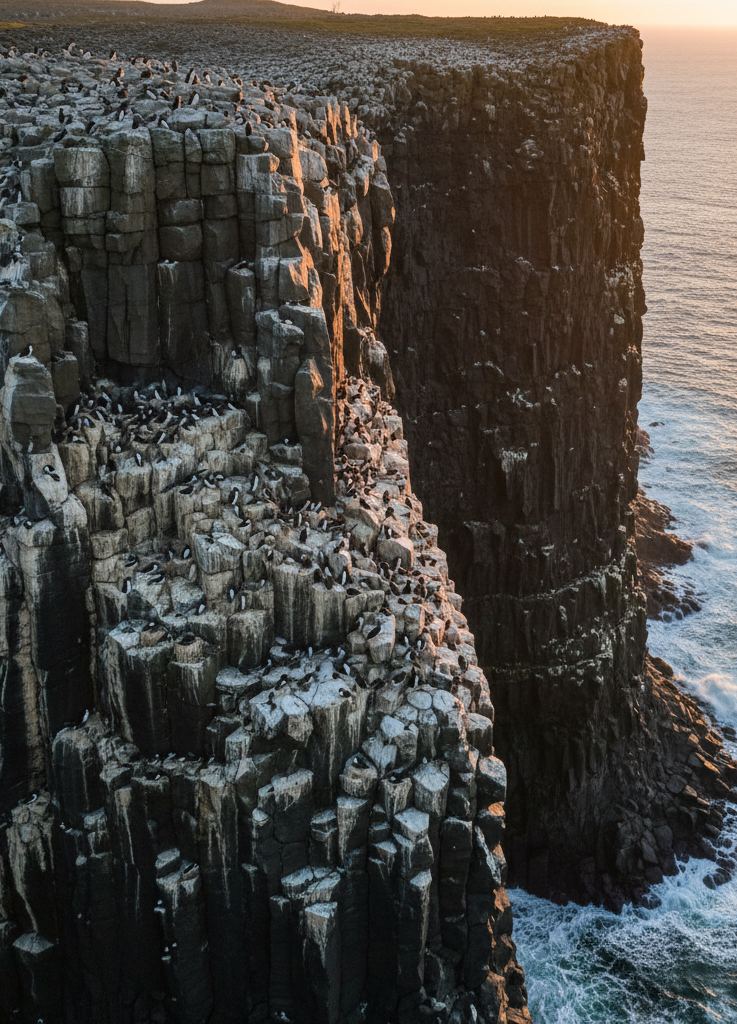
Dynjandi falls about 99 m down seven steps, 30 m wide where it starts and 60 m wide where it lands, and you hear it from the parking area before you have seen the top of it. The heath road that gets you there tops out near 500 m and holds snow into June most years. The old 552 m pass on the shoulder above the northern fjord has been a summer only road since the tunnel took the through traffic, and it is worth driving once for the drop on the far side.
Sea temperature off the north coast runs 6 to 8 degrees C in the third week of June. Air sits at 8 to 12 in the afternoon and 4 to 6 at 01:00, and the wind comes down the fjords lengthwise rather than across them, so a headland that is calm on one side is not calm on the other. Arctic terns are on eggs the whole time and will come at your head inside thirty meters of a nest. The reserve on the north coast has no road, no shop, and no phone coverage over most of its area.
- 11:00
- breakfast is still out and nobody has been up long
- 13:00
- the drive, forty minutes or four hours depending on the day
- 16:00
- the cliff, the red sand beach, or the crossing to the reserve
- 19:00
- the evening meal, which about half the group sleeps through instead
- 22:30
- the light has not changed since four in the afternoon
- 00:45
- the vehicle leaves for whichever horizon is open
- 01:33
- the sun bottoms out on the water and starts climbing
- 02:15
- back at the rooms with the sky exactly as it was
Why the sixth of June and why the sixth of July
Two things open it. The sun stops setting on the outer coast at about June 6, and the heath roads that reach that coast are usually clear enough to drive by then. One thing shuts it. Around July 6 the disc begins going under again at the same latitude, and by July 20 it is below the horizon for roughly three and a half hours a night, which is still a bright sky but is not the thing you came for.
A fortnight early is not a small difference. On May 23 the sun is under for the same three and a half hours it is on July 20, the passes may still be on snow clearing, and the boat into the reserve is usually not yet running, so the two reserve days would come out of the trip altogether. A fortnight late hands you the birds at full strength, easier roads and a warmer sea, and takes the hour away. Both of those are perfectly good trips. Neither of them is this one.
None of this is a promise about what you will see. The position of the sun is arithmetic and does not vary. Cloud does, and a run of low grey off the sea can sit on this coast for three nights together. When it does, the sky at 01:33 is still bright enough to read a map by and the disc is simply not in it, and the invoice reads the same either way.
How a booking on these dates is put together
Choose the week you want and this office puts that exact week to the company that runs it. A real figure comes back inside two to four working days, since the operator prices each departure on its own and not by season. Nothing described above belongs to Roving Hours Bookings LLC: not the rooms, not the nine seat vehicle, not the boat, and not the aircraft you arrive on. The crossing to the reserve and back is held by the operating company under its own licence, and it is that company, not this one, that invoices you on its own paper and under its own terms.
The seat from Orlando is yours to arrange, and no air ticket of any kind is sold here. Everything else on this page goes through as one reservation with the operating company, and nothing is taken from you at this end at any stage.
Roving Hours Bookings LLC is the company behind this page, it operates under the name Roving Hours, and its office is at 1350 N. Orange Avenue, Suite 221, Orlando, FL 32789, in Orange, Florida. Questions about a particular week go to +1 (407) 629-3157 or to bookings@rovinghours.com. If a figure here has drifted out of date, send it to corrections@rovinghours.com and it gets checked against the operating company.
Start with the weeks, not the country
This form takes requests every hour of every day, and a person answers within one business day. Nothing here commits you. No figure is charged at this end.