hooded birds on the saddle prop, gravel, wind off the hill
Reserve a Bayan-Olgii eagle festival trip, the first ten days of October
Eleven nights in the far west of the country, four of them in the Altai valleys where the birds are kept and two of them on the festival ground outside Olgii town, from $5,187 per person with two of you sharing a room. The festival is two days long and it is the whole reason the window exists: somewhere around a hundred Kazakh hunters ride onto a flat piece of gravel with a golden eagle sitting hooded on the arm, and the birds are called down off a ridge to a raised fist while a loudspeaker keeps the time.
Reserve a windowAn answer is written inside one business day by somebody at this end.
The festival ground is a flat piece of gravel under a low hill about eight kilometres out of Olgii town, and for two days at the beginning of October something in the region of a hundred Kazakh hunters ride onto it with a golden eagle sitting hooded on the arm. You can reserve a Bayan-Olgii eagle festival trip with Roving Hours for the eleven nights built around those two days. Four of the eleven are spent on a track, two days south into the Altai valleys where the birds are actually kept and two days back up again, from $5,187 per person with two of you sharing.
The order of it is deliberate. The valleys come first and the ground comes last, partly because the two festival days are fixed and everything else has to bend around them, and partly because the fords on the way south harden as the month goes on. By the middle of the month the second crossing is a morning of chipping ice off a bumper rather than a wade, and that is one of the two things that shuts this window on October 10.
The other is light. On October 1 the sun is up at 07:00 and down at 18:40. By October 10 it is 07:13 and 18:21, so the window loses about half an hour of daylight across its own ten days, and the last stretch of driving happens in the dark either way.
Runs October 1 to October 10.
It opens on whichever weekend the organizing committee fixes, which for years now has fallen inside the first ten days of the month, and it shuts because the fords on the track south begin taking ice overnight and the two driving days each way stop being two.
The weekend can sit anywhere between October 1 and October 7 depending on which day the first Saturday lands on, a drift of about six days, so we build the eleven nights around whichever Saturday it turns out to be, mark the dates provisional in writing until the committee settles them in the summer, and tell you what the same weekend fell on for the last four years.
Before dawn until after dark. Programming begins around 05:30, some ninety minutes ahead of the sun, and stops somewhere past 21:00, since the vehicles have to load in the dark to be parked before the hunters ride in, the judged calling occupies 09:30 through to about 17:30, and each bird is weighed, fed and hooded by lamp once it is back at the tether.
What is left is a flat two hours after the middle meal, when the wind gets up and most people eat sitting in a vehicle with the door shut, plus whatever you make of a track that puts a hundred and forty kilometres between one valley and the next.
11 nights, from $5,187 per person.
The festival runs on its dates whatever the weather does, so those two days are about as fixed as anything on this website gets; what nobody underwrites is the birds. A bird that has been carried in a vehicle for two days will sometimes sit on the hill, look at the crowd and refuse the call, and in an ordinary year a good number of entries do exactly that and get carried back down by hand, so reckon on seeing a great many eagles and on some of them doing nothing whatever.
- What this office books
- This office books the eleven nights of beds, every meal, two vehicles and their drivers, a guide who speaks Kazakh as well as Mongolian and English, entry to the festival ground on both days, the national park fee and the border zone permit the operating company obtains for the southern valleys; it books nothing that leaves the ground, and it takes no money from you at any point in any form.
- Who books it
- A person reserving this wants both halves of it, the ground outside town with a hundred birds on it and a loudspeaker going, and then a side valley four days earlier where one bird goes off a ridge with nobody watching except the family that feeds it.
- Why somebody picks another window
- If what you want is the hunting itself, come in the second half of January instead, when snow holds a track well enough to follow a fox, and accept that there is no festival, no crowd, no loudspeaker and mornings at minus thirty.
- In the figure
- Eleven nights on two sharing, three of them in a guesthouse in town with hot water in the evenings, four in felt tents with a stove lit at dusk, and four in winter houses and a herder camp along the track; every meal from the first evening to the last breakfast, which in the valleys means boiled mutton, hand cut noodles, salted milk tea and fried dough off the stove; two vehicles and two drivers for the whole eleven days, including four full days on track and eleven river fords; a guide who speaks Kazakh as well as Mongolian and English, and who knows which families are flying birds that week; entry to the festival ground on both days, held by name before any other line is priced; the national park fee for the southern valleys; the border zone permit the operating company obtains and holds under its own paperwork; four mornings on a ridge with a hunting family, from first light to whenever the bird has been fed; a felt blanket and a spare down layer per person carried in each vehicle; drinking water carried for eleven days, because there is none to buy past the second morning; all fuel for four days of track driving, which is a bigger share of the figure than the beds are.
- Not in the figure
- Your flight, which is yours to arrange and yours alone and which no line of this figure touches: Orlando out to the capital and home again, routed through one Asian hub or two, has come in at $1,650 to $2,850 depending on the week; crossing the country westward and back, however you settle on doing it, which this office neither arranges nor holds, $250 to $520; reaching Orlando itself in both directions, with a bed near that airport if the timings force one on you, $120 to $200; a room to yourself instead of sharing, $430 to $610 across the eleven nights; tips for the two drivers and the guide together, $18 to $28 per traveller per day; drink beyond the tea and the water that come with meals, $2 to $7 each; hire of a down coat, felt boots and heavy gloves at the start rather than carrying your own, $70 to $120 for the trip; a horse for a day in the valleys from the family that owns it, $25 to $45; anything bought at the market in town, from about $30 for a piece of felt work up to several hundred for a wall hanging; laundry in town, $6 to $15 a bag; a second vehicle held for your use alone rather than shared, $180 to $260 a day.
- Who this window will not suit
- Do not book this if an early start is a problem, because the vehicles load at half past five in the dark on both festival mornings, and the valley days put you on a ridge before the sun and keep you there. The felt tents have one stove, no running water and a pit dug behind a screen; the track south and back is four full days with fords, corrugations and no paved surface at all, and being sick in a vehicle on the second day is common enough that the drivers stop for it without being asked. The valleys sit between 2,300 and 2,600 metres and the track crosses higher than that, which a lot of people feel as a headache and a poor first night of sleep. And there is a real chance that the bird you have travelled eleven days to watch sits on the hill, ignores the call and has to be fetched, and that a fair part of those two days is wind, gravel dust and standing about in the cold waiting for the next number to be read out.
A starting figure for two people sharing one room. Pricing the exact window you pick runs two to four working days, because the company working those dates answers first. No air ticket is ever folded in.
What the two days on the ground actually consist of
The hunters ride in from three directions between about eight and half past nine, and the first hour is entirely people arriving: fox fur hats, coats seamed in red and green, a hooded bird on the forked prop, a helper alongside carrying a second. Nobody starts anything until the judges have counted the entries, which are called by name and by district over a loudspeaker mounted on a small truck.
Then the calling starts, and it is the same thing repeated seventy or a hundred times, which is why the day is long. A helper carries the bird up the hill behind the ground and takes the hood off. The hunter waits below on horseback with a piece of meat and one arm raised, shouting, and the bird either comes down or it does not. When it comes it is over your head in seven or eight seconds, dropping the last thirty metres with its feet forward, and the noise it makes hitting the arm carries to the back of the crowd. When it does not come, and it fairly often does not, the hunter keeps shouting for a minute and a half and then somebody walks up the hill and brings the bird down by hand. Both of those count as a turn taken.
The second thing they are judged on is a fox pelt dragged behind a horse at a canter, which the bird has to come off the hill and strike. That is the event where a bird occasionally goes past the pelt entirely and puts itself down in the middle of the crowd, and the crowd moves.
The afternoons are horses rather than birds. There is a tug of war over a goat skin between two riders, done at a standstill and then at a gallop; a coin picked off the ground at a canter without stopping; and a race in which a girl chases a boy with a whip and uses it if she catches him. None of that is scored on the same sheet as the eagles. It is what fills the middle of the day while the birds are hooded on the prop and out of the wind.
One day on the ground, from the dark to the dark
Below is an ordinary first day, in western time, an hour behind the capital. Read the middle of it as tendency and not as a schedule, because the calling runs at whatever speed the birds decide on.
- 05:30
- vehicles loaded outside the guesthouse in the dark, flasks filled, very little conversation
- 06:15
- out of town on eight kilometres of road, the last two of them gravel, parking before the crowd
- 07:13
- sun up behind the ridge, though the ground itself stays in shadow another forty minutes
- 08:20
- hunters ride in from three directions, birds hooded, helpers on foot beside the horses
- 09:30
- the calling begins, one bird at a time up the hill and one hunter at a time waiting below
- 12:40
- a flat two hours, mutton and noodles eaten in the vehicle with the door shut against the wind
- 14:00
- horse events on the same ground, the goat skin, the coin pickup, the chase with the whip
- 17:20
- placings read out over the loudspeaker, and the ground empties inside about twenty minutes
- 20:40
- back at the tether in town, birds weighed, fed and hooded for the night by lamp
Four days of track, and the reason for them
The ground outside town is where the birds are shown. The valleys south of it are where they live, and reaching them takes two days of driving in each direction, a third of this trip and not padding.
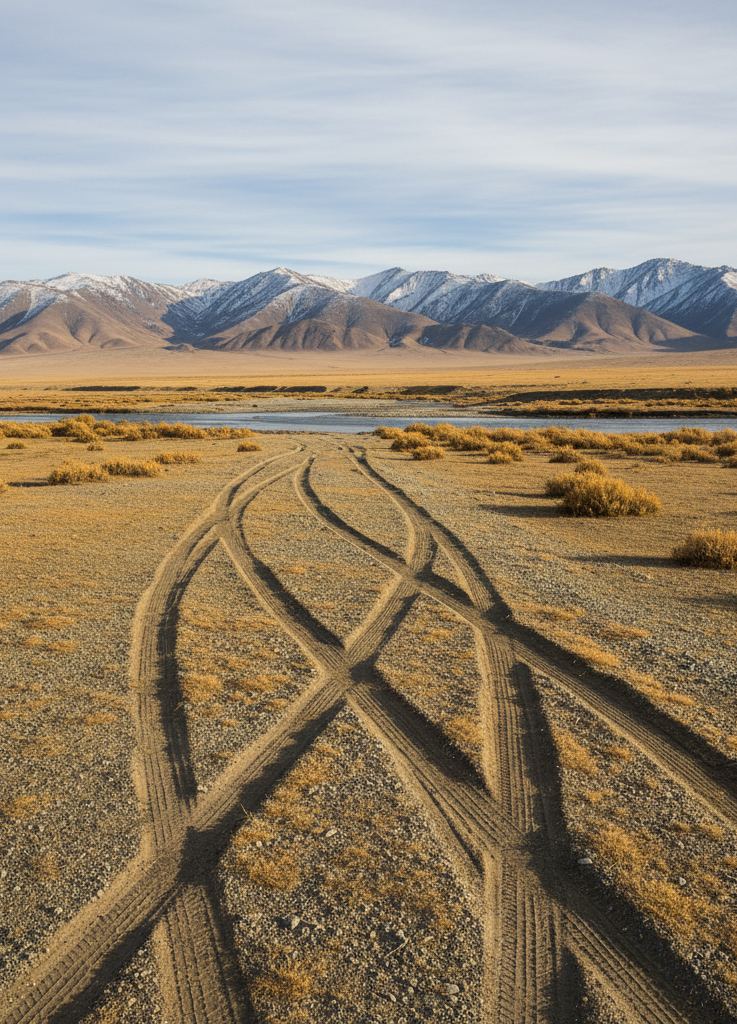
The paved surface runs out about forty kilometres from town. After that it is track: braided sets of wheel ruts across gravel plain, a river to cross eleven times in total, and two passes to get over, the higher of them at a little under 2,900 metres. Reckon on seven or eight hours of movement on each of the four driving days, at an average that rarely gets above thirty five kilometres an hour, with a night halfway in a winter house belonging to a family that keeps the route open. No fuel is sold past the first morning and no water past the second, so both are carried.
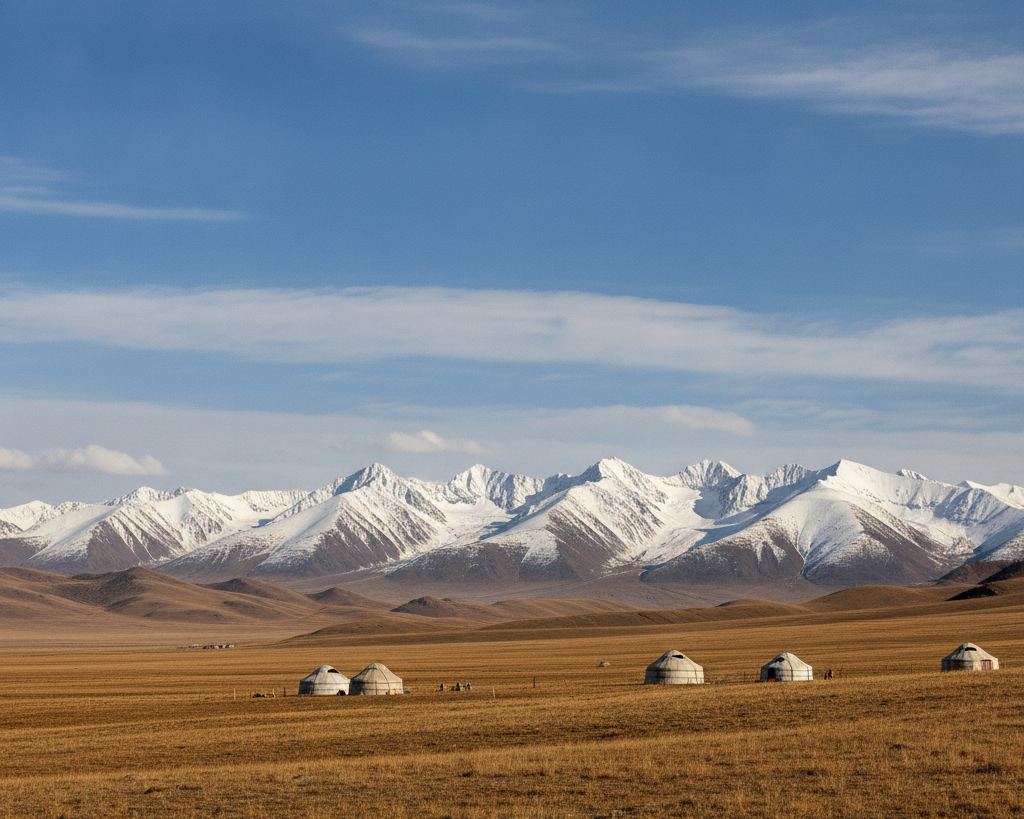
What is at the end of it is four nights in felt tents in a side valley at about 2,400 metres, with three or four households in it and perhaps six birds between them. The mornings there are the reverse of the festival: one bird, one ridge, one man, nobody watching, and forty minutes of walking uphill in the cold to get into a position where you can see the release and the stoop in the same frame. The birds are all females, taken as chicks off a nest ledge or trapped in their first year, kept five to ten seasons and then let go on the mountain to breed. The family knows which bird is in which year and how many it has left.
What the first ten days of October are not
They are not the hunting. That has to wait for snow, because a fox leaves nothing to follow on dry gravel, and the snow arrives in November. What you get in this window is a bird flown to a lure, a bird flown at a dragged pelt, and a bird flown to the arm, which is training and demonstration and is the honest description of it. Anybody selling you a fox hunt in the first week of October is selling you something that is not happening yet.
They are also not warm. Twelve degrees on the gravel with a steady wind is colder than the number reads, and the valleys at 2,400 metres take the night to minus 15 with one stove per tent, lit at dusk and out by eleven.
And they are not quiet. The festival brings several hundred visitors into a town of thirty thousand, every guesthouse bed in it is spoken for by August, and the road out to the ground on the first morning is a slow line of vehicles from six o'clock. The four valley nights at the front of the trip exist partly to give you the other version of the same thing before the loudspeaker starts.
Send us the week you can travel and we will come back with a written figure. Two to four working days is what that takes on this one, and the reason is specific: the festival entry has to be held by name, and the border zone permit for the southern valleys is applied for on paper, so the number gets assembled rather than looked up.
None of what is listed on this page belongs to Roving Hours Bookings LLC. Not a vehicle, not a stove, not a felt wall, not a metre of that track, and certainly not a bird. Whichever company is working those dates is the one that puts a bill in front of you, under its own conditions and on its own timing, and it is the one that says when it wants paying. This office asks for no deposit, keeps no card on file, and has nothing on any of its pages to pay.
Nothing that leaves the ground is in the figure either. Getting into the country and out of it again is yours from one end to the other, and so is crossing it to the west; the eleven nights begin when you are standing in Olgii town and end when you leave it. All of this is put together at 1350 N. Orange Avenue, Suite 221 in Orlando, Orange County, Florida 32789, and that is the whole of what goes on there. +1 (407) 629-3157 reaches a person, bookings@rovinghours.com reaches the same person in writing, and corrections@rovinghours.com is where to write if anything on this page is wrong.
Start with the weeks, not the country
This form takes requests every hour of every day, and a person answers within one business day. Nothing here commits you. No figure is charged at this end.