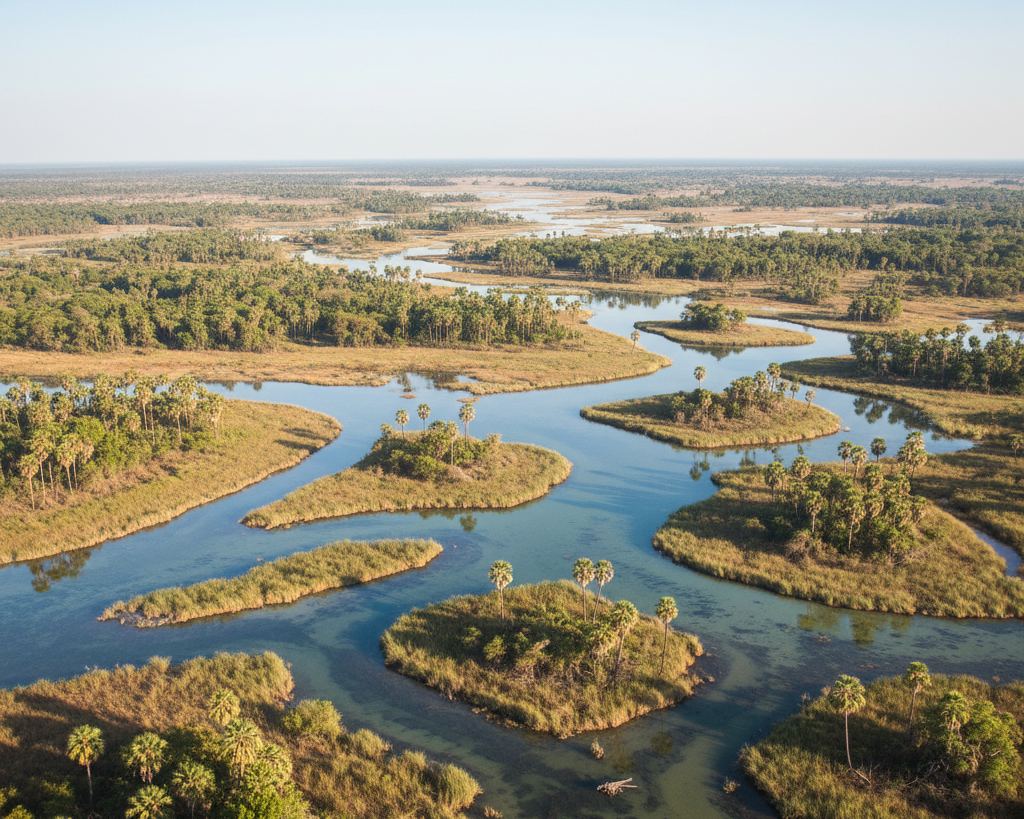
cold clear water standing over ground that was cracked clay in april
Reserve an Okavango Delta flood trip, late May to the end of August
Eight nights in Botswana, five of them on islands inside the flood itself, held on any week you name between the last days of May and the end of August, from $6,939 per person with two of you sharing. The water you will be sitting on fell as rain on the Angolan highlands about five months earlier and has spent the time since walking south across sand, and it arrives in the driest month Botswana has, which is the whole reason the animals are standing in it.
Reserve a windowAn answer is written inside one business day by somebody at this end.
The rain that makes this trip falls in Angola, on the highlands north of the border, mostly between December and March, and not one drop of it lands in Botswana. It goes into the Cubango and the Cuito, comes down through the panhandle at the top of the country, and then takes something close to five months to walk south across a fan of Kalahari sand while Botswana itself has no rain at all. You can reserve an Okavango Delta flood trip with Roving Hours for the weeks that water is standing on the plain. Eight nights, five of them on islands inside it, from $6,939 per person with two of you sharing.
The dates are the entire point of it. Stand on the same ground in April and you are looking at cracked grey clay, grass past the knee and mokoro lying on their sides at the village with nothing under them to float. Stand there in the last week of May and the same ground carries forty centimetres to a metre of clear cold water, moving south at about the pace of a person walking, and the animals that were scattered over four hundred kilometres of dry country in March are standing in it.
Most of the daylight is programmed and none of the dark is, which is deliberate. On the water the useful part of the day begins before the air has warmed and runs until the light goes flat, and there is nothing to be gained here by building a trip around one hour of it.
Runs the last week of May to the last week of August.
It opens when the flood front has pushed far enough down the fan to put poling depth on the plains east and south of Chief's Island, which normally falls inside the last ten days of May, and it shuts at the end of August, when that water has started to drop off the shallow ground and the afternoons have gone past thirty degrees.
The front can run two or three weeks early or late depending on what fell in Angola the previous January, so we set your eight nights against the dates you are actually able to travel and tell you what the gauge at the top of the panhandle was reading in the same week the year before.
Most of the daylight. The programmed hours run from about 06:30, when the mokoro come off the mooring, until the polers bring them back onto it between 17:00 and 17:45, with three hours in the middle of that spent off the water on an island because almost nothing moves at midday.
The rest of it is dark, and the camp does not travel in the dark: dinner at a fire, reed frogs going all night from about a metre outside the canvas, no power once the fire is down, and a member of the camp staff walking with you between the fire and your bed, which is how these camps are run.
8 nights, from $6,939 per person.
The flood has come every year on record, but how far down the fan it reaches and how high it stands vary by well over a metre between one year and the next, and a weak year can shorten the poling route to a third of what a strong one gives you. Nobody underwrites the water level, not this office and not the company running the camp, so the trip runs on whatever water arrived that year and the figure holds either way.
- What this office books
- This office reserves the eight nights, the meals, the road transfer out of Maun and the five days of poling and walking with the company holding those concessions; the passage over water is that company's own, run under its own Botswana licence and billed by that company, and nothing that flies is arranged here at any point.
- Who books it
- A person reserving this wants to be sitting a hand's width above water that is moving south at walking pace over ground that carried dust in April, close enough to hear the pole come out of it.
- Why somebody picks another window
- If what you are after is newborn lechwe, thunderheads over the plain and the whole country green, take January or February instead and accept that the floodplain you would have poled across will be dry grass and the mokoro will be up on their sides at the village.
- In the figure
- Eight nights on two sharing, five of them under canvas on islands inside the flood and three at a lodge on the river at Maun, split between the front and the back of the trip; every meal from dinner on the first night to breakfast on the last, cooked over fire and gas once you are on the islands; the road transfer out of Maun to the mooring, the last two and a half hours of it on sand track; one mokoro and one poler for every two travellers across five days, with the poler's wages, food and camp place counted in; a licensed Botswana guide on every walk and every hour spent on the water; guided walks on the islands, two to three hours at a time, taken at whatever pace the group actually holds; the government park and concession fees for each day you are inside them, counted per person per day and held before anything else is priced; drinking water carried out with the camp, which is the only water on the island you can drink; a canvas chair, a bucket shower filled hot at dusk, and a long drop dug for the camp; the fire, the wood for it, and a staff member walking you back to the tent after it.
- Not in the figure
- Your flight, which forms no part of this and stays your own arrangement from the day you leave to the day you get home: Orlando to Botswana and back, by way of two hubs on almost any routing, has been running $1,850 to $3,100 depending on how far ahead it is held; getting yourself to and from Orlando, plus a room by that airport the night before if you want one, $110 to $185; the internal leg from your point of arrival in the region to Maun if you land somewhere else first, $180 to $420 each way and put together by you; tips for the polers, which the camps put at $10 to $15 per traveller per day and which are handed over in cash at the end; tips for the guide and the camp staff together, $12 to $20 per traveller per day; drinks beyond the water and tea that come with meals, $3 to $8 a bottle at the river lodge and carried in at your own cost on the islands; a room to yourself at either end of the trip instead of sharing, $95 to $160 a night; laundry at the river lodge, which is the only place on the trip with any, $9 to $18 a bag; water shoes and a dry bag bought in Maun rather than carried from home, $30 to $70 for the pair; anything bought from the poling villages on the way in, $8 for a woven grass lid and up to $200 for a full basket; a sixth day added to the island nights at the front or the back, $140 to $210 per person.
- Who this window will not suit
- Do not reserve this if you need a room that locks, because five of the eight nights are canvas on an island with nothing built around it, no power once the fire is down, and a bucket of hot water at dusk in place of a shower. The mokoro sits about a hand's width above the surface, you ride on the floor of it with your legs straight out in front of you for two and three hours at a stretch, and getting in and out is done off wet ground onto a hull that moves while the poler holds it. June and July mornings begin in the dark at four or five degrees, and the first two hours of them are spent sitting still. And there will be days when the whole of what passes you is reed, lily, a hundred red lechwe at four hundred metres and one fish eagle, because nothing out here is on a schedule and a sitatunga or a fishing owl can go the entire eight nights without showing itself.
A starting figure for two people sharing one room. Pricing the exact window you pick runs two to four working days, because the company working those dates answers first. No air ticket is ever folded in.
How Angolan rain becomes Botswana water
The whole delta is a fan of sediment dropped on Kalahari sand inside a shallow trough between two faults, and the ground falls about sixty metres across two hundred and fifty kilometres of it. That is a gradient of roughly one in four thousand. Nothing on it runs. The water spreads, splits into channels a few metres across, blocks itself with papyrus and sediment, cuts a new way through, and creeps forward at something on the order of a kilometre a day when it is on the move at all.
Which is how a river ends up out of step with its own rainfall by five months. The peak at the top, where the river comes in across the border, is in March and April. The peak at the bottom, on the plains you are poled across, is in July. In between, the country around the delta is having its dry season: no rain since April, grazing burnt off, pans gone, temperatures dropping at night to four degrees in June and climbing to thirty three by the end of August. The flood arrives into all of that, several months late and from somewhere else, and it is the only water for a long way in any direction.
The consequence you actually see is animals concentrated on the edges of it. Red lechwe stand in the shallows and run through them rather than around them, which is what their hooves are shaped for. Elephant cross the channels in the late afternoon with the young ones swimming. Buffalo work the flooded grass in the hundreds. Hippo decide which channels the polers use and which they do not, and the poler will take a longer line without discussing it.
The water's calendar
The line below is what a normal year does. Read it as a tendency rather than a timetable, because the deciding rain fell in another country five months before you arrive and nobody there is announcing anything in advance.
- December to March
- rain on the Angolan highlands, a thousand millimetres and more of it, none of it in Botswana
- late February
- the gauge at the top of the panhandle starts climbing where the river crosses the border
- March and April
- the panhandle is at its fullest, a corridor of papyrus fifteen kilometres wide, and the front starts down the fan
- May
- the front reaches the plains east and south of Chief's Island at roughly a kilometre a day, and the window opens in the last ten days
- June
- poling depth over most of the plain, dawn air at three to seven degrees, the shortest light of the year at 07:04 to 17:52
- July
- the peak at the bottom end, and the month the channels near Maun fill if they are going to fill at all
- August
- the water holding and then beginning to fall, afternoons past thirty by the final week
- September
- the plain drying back to grass, the poling routes getting shorter, the window shut
- October
- dust, thirty eight degrees in the shade, and the first rain still a month away
Five days at the speed of a pole
A mokoro is a shallow dugout, now usually moulded in fibreglass off an old wooden hull, carrying two travellers sitting on the floor with a poler standing at the stern working a pole about three metres long. It makes something under three kilometres an hour. There is no engine, no seat and no shade, and the freeboard is a hand's width, so the water is at the level of your elbow the entire time.
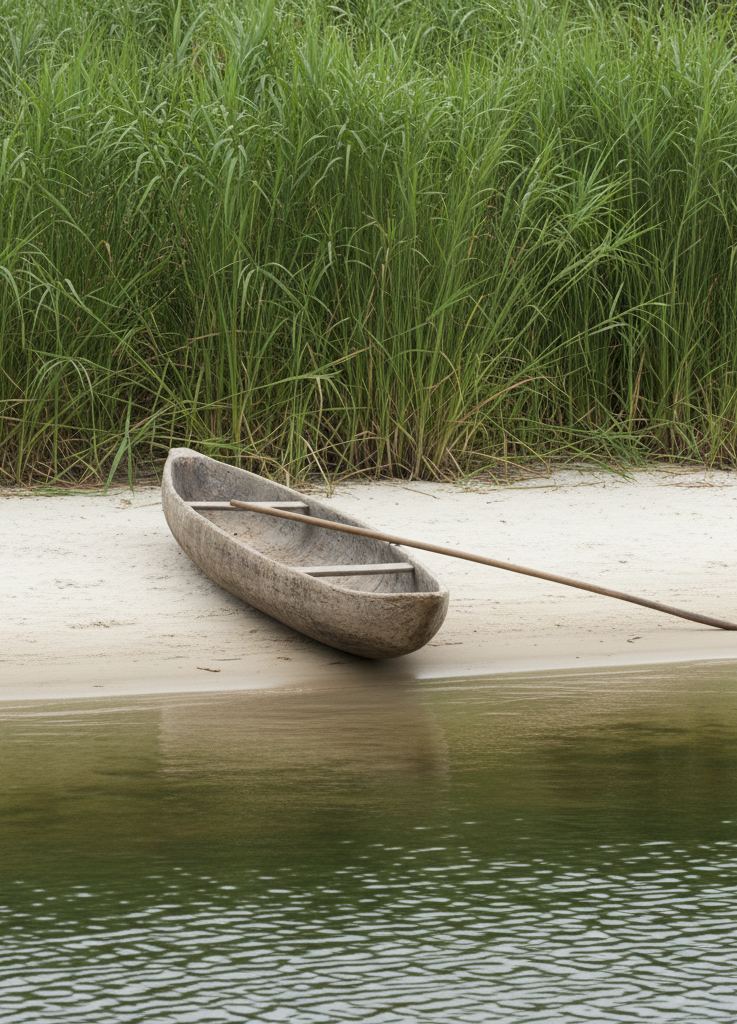
That is the reason this trip is built the way it is. You are moving slowly enough that the day has to be long: out at 06:30 with frost on the grass on the coldest mornings, three or four hours on the water while the light is low, then onto an island for the middle of the day, when the air is at twenty six or twenty eight degrees and the lechwe have gone into the shade and stopped doing anything worth poling toward. Camp is set on the island. Lunch is cold and eaten under a tree. Then a walk, or a second stretch of water, and back on the mooring somewhere between five and a quarter to six, which is about when the light goes.
The two things you are on the water for are both small. One is the sound: a pole coming out of sand, water off the blade of it, reed moving on the hull, and otherwise nothing mechanical for five days. The other is the day lilies, which open blue in the morning and shut in the afternoon, while a second and larger white one opens after dark and is closed again before you are up. You pass through several hundred metres of them at a time and the hull pushes them under and they come back up behind you.
Coming a fortnight early, or a fortnight late
Arrive in the second week of May and the odds are the front has not made the plains yet. The channels carry water, the permanent swamp is where it always is, and the camps on the islands are reachable, but the shallow ground you would be poled across is still drying grass, so the five water days shrink to two and the rest of it becomes vehicle and foot. That is a genuine week in a genuine place, and it is not this trip, and the office will tell you so rather than sell you the dates.
Arrive in the middle of September and it reverses. The light is longer, sunrise back to 06:15 and sunset out past 18:25, the mornings are no longer cold and the camps are quiet. But the water has begun to leave the shallow plain, the poling lines are shortening week by week, and by the end of the month the mokoro are working a fraction of the ground they had in July. If the warm mornings matter to you more than the water does, take the later dates on purpose and with the loss set out in front of you.
The three weeks this office would pick for you, if nothing at your end fixed the dates, are the ones either side of the middle of July. That is when the water on the lower plains most often stands at its highest, the poling routes are at their longest and the animals have had two months of everything else in the country drying out behind them.
Send the weeks you are able to travel and a costed answer comes back inside two to four working days, worked against your dates and not against an average, because five days of polers, a camp that has to be carried out and put up, and per person concession fees counted by the day are built up line by line rather than looked up. Not one item on the list above is owned at this address: the tents, the mokoro, the vehicle out of Maun and the licence covering the water are all held by the operating company in Botswana, and whichever company is working those concessions on your dates is the one that writes the invoice, on its terms, straight to you. Nothing with wings is included at any point and the journey out stays yours to arrange. Roving Hours Bookings LLC, which does business under the name Roving Hours, keeps an office at 1350 N. Orange Avenue, Suite 221, Orlando, FL 32789, in Orange County, Florida, and the agents there place reservations and do nothing else. Questions by telephone on +1 (407) 629-3157 or in writing to bookings@rovinghours.com; anything factual on this page that needs correcting goes to corrections@rovinghours.com, and if you would rather have the whole of it back as one written piece, say so and it will come that way.
Start with the weeks, not the country
This form takes requests every hour of every day, and a person answers within one business day. Nothing here commits you. No figure is charged at this end.