cold water at ten to four, frogs, two hundred paddies
Reserve a rice terrace trip in Niigata for the mirror fortnight in May
Six nights in a farmhouse village below the terraces above Tokamachi, in the second half of May, from $4,629 per person on two sharing. The fortnight is the one in which the paddies have been flooded and puddled and the seedlings are not yet tall enough to break the surface, so the slope reflects. Five of the six mornings are spent standing on the bank from before four.
Reserve a windowAn answer is written inside one business day by somebody at this end.
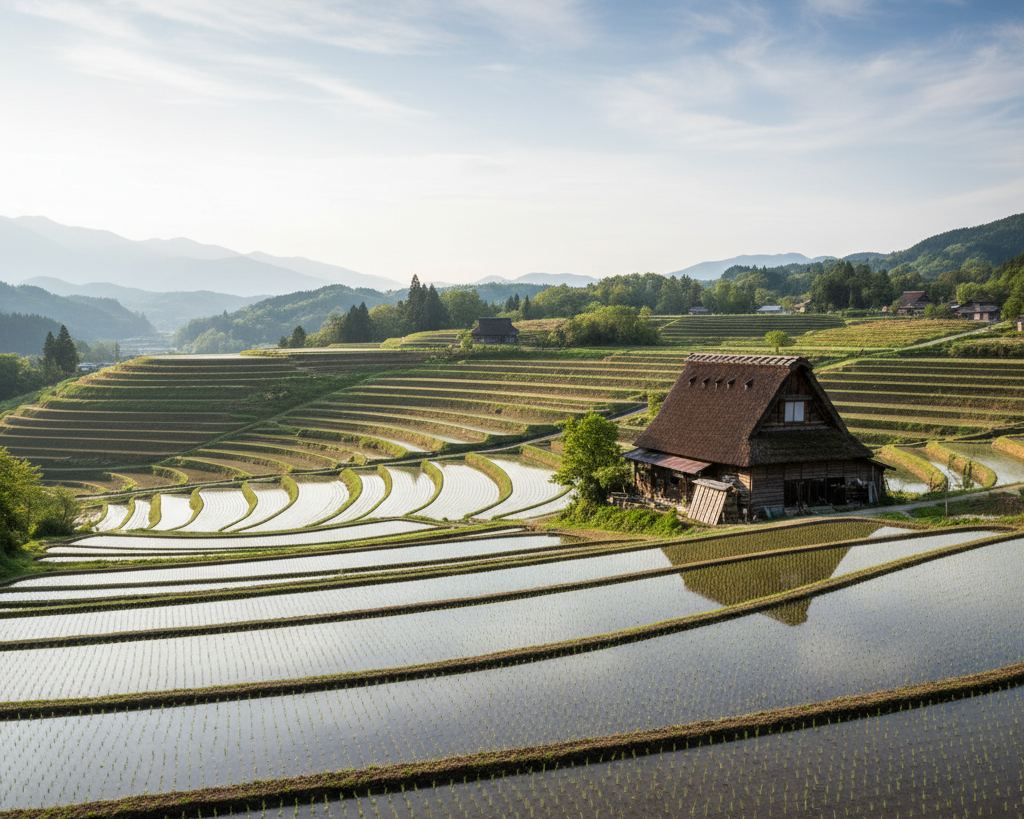
Reserve a rice terrace trip in Niigata and what you are holding is a fortnight rather than a destination. The slope above Tokamachi stands there all year, and for most of the year there is nothing on it that would justify a 02:40 alarm. For about seventeen days in the second half of May the households that farm Hoshitoge open the ponds cut into the hill above the fields, run water down into roughly two hundred paddies, churn the soil under that water until it settles out smooth, and put the seedlings in. In the gap between the water going on and the rice standing up, the hillside works as a mirror.
That is the offer in full: six nights in the village below the terraces, five programmed dawns, from $4,629 per person on two sharing. Roving Hours reserves the farmhouse, the vehicle and driver, and the access arrangement with the families whose field banks you will be standing beside. The office owns none of those things. Not a room, not a van, not a metre of the slope.
The dates are narrow for agricultural reasons rather than scenic ones. Water goes on when the snowmelt ponds have filled and the ground has stopped freezing overnight. The seedlings follow within a day or two of puddling, because settled slurry is what holds a young plant upright. Once the plants clear 25 centimetres the surface is broken up by rice and the slope reads as ordinary green farmland, which happens eighteen to twenty four days after the last field is planted. There is no version of this trip in July.
Runs May 14 to May 30.
The window opens when the snowmelt ponds have filled and the ground has stopped freezing overnight, so the households can flood and puddle the upper fields, and it shuts when the transplanted seedlings stand tall enough to break the water and take the reflection with them.
The dates move by up to ten days either way depending on how deep the winter lay, so the office holds the farmhouse across a wider spread and confirms your six nights in the first half of April, once the village has agreed its planting order.
A morning or an evening. The trip is programmed for the block from 03:15 to about 07:30, which is the only stretch of the day when the air is still enough for the paddies to hold anything.
The rest of the day is unstructured and mostly horizontal: breakfast at eight, sleep from nine until one, then the valley road, the ponds, the weaving sheds in town, a bath, and an early dinner.
6 nights, from $4,629 per person.
The flooding is certain, because it is farm work on a schedule that has to happen; the reflection is not, because it needs air under about a metre and a half a second and a sky with some structure in it, and roughly four dawns in six give both. Nothing about the weather is underwritten by this office or by the firm on the ground, and the price does not move with what the sky does.
Everything under that mark is decided in the valley and not in Orlando. The planting order among the households is agreed in the first half of April, once the winter's snow depth is known and the ponds can be measured, and your six nights are confirmed against it then rather than at the moment you first ask.
- What this office books
- The office books the six nights in the village, the road transfer from the station and back, and the operating company's dawn programme with its field access arrangement; it does not book your flight and it takes no money for any of it.
- Who books it
- A person booking this wants to stand above a worked hillside on the few mornings a year when it reads as water rather than as farming, and to have the light do that work.
- Why somebody picks another window
- If you want the terraces green and legible as terraces, with the rows visible and the mornings warm enough to stand about in, late June or the first week of October gives you that and does not ask you up at twenty to three.
- In the figure
- Six nights in a five room farmhouse in the village below the terraces, two sharing, shared bath; breakfast each morning after the dawn block and dinner on five of the six nights; the road transfer from the nearest station on arrival and back at the end; five programmed dawns with the local operating company, vehicle, driver and a guide who works these fields himself; the field access arrangement with the households that farm the slope; hot drinks and a windbreak on the bank from 03:50; one afternoon arranged around the weaving sheds and the cloth bleaching ground in town; one afternoon planting a small upper terrace by hand alongside the household that owns it; one mid week laundry; and all local taxes on the ground services.
- Not in the figure
- Round trip air from Orlando to Tokyo, which is your own arrangement, typically $1,150 to $1,950 depending on routing and when you buy; the train north from Tokyo and back, $50 to $75 each way; the sixth night's dinner, $18 to $40; lunches, $8 to $22 a head; rubber boots if you do not bring your own, $25 to $45 to buy in town; a single room in place of two sharing, $610 for the six nights; extra nights at either end, $185 per person per night; drinks with dinner, $4 to $12 a glass; coin laundry beyond the one wash included, $4 a load; and anything the operating company invoices separately for a change of dates after confirmation, $0 to $240.
- Who this window will not suit
- The alarm goes at 02:40 on five of the six mornings and you stand still in the cold for three hours after it, so a person who cannot sleep in the early evening will be worn through by the third day. The bank is wet packed earth with no railing and no lighting, the drop from one terrace to the one below is about a metre, and the walk in from the pull off is 200 metres of mud in the dark. Nothing is programmed between breakfast and dinner and the nearest town of any size is 25 minutes away on a road with passing places, so anyone who wants a filled day will be bored by Wednesday. And there is a real chance that three of your five dawns come up flat grey with wind, and you go home with the fields but not the reflection.
A starting figure for two people sharing one room. Pricing the exact window you pick runs two to four working days, because the company working those dates answers first. No air ticket is ever folded in.
What is under the water
This part of the prefecture takes as much snow as anywhere that people live through the winter. Two metres on the ground in February is unremarkable, and the terraces stay under it into early April. That snow is the water supply. It runs into ponds dug into the slope above the top row of fields, and every paddy below is filled from those ponds rather than from a river, which is the reason planting here sits one to two weeks behind the flat land of the Echigo plain forty kilometres to the north, where the water warms earlier and the machines can get on.
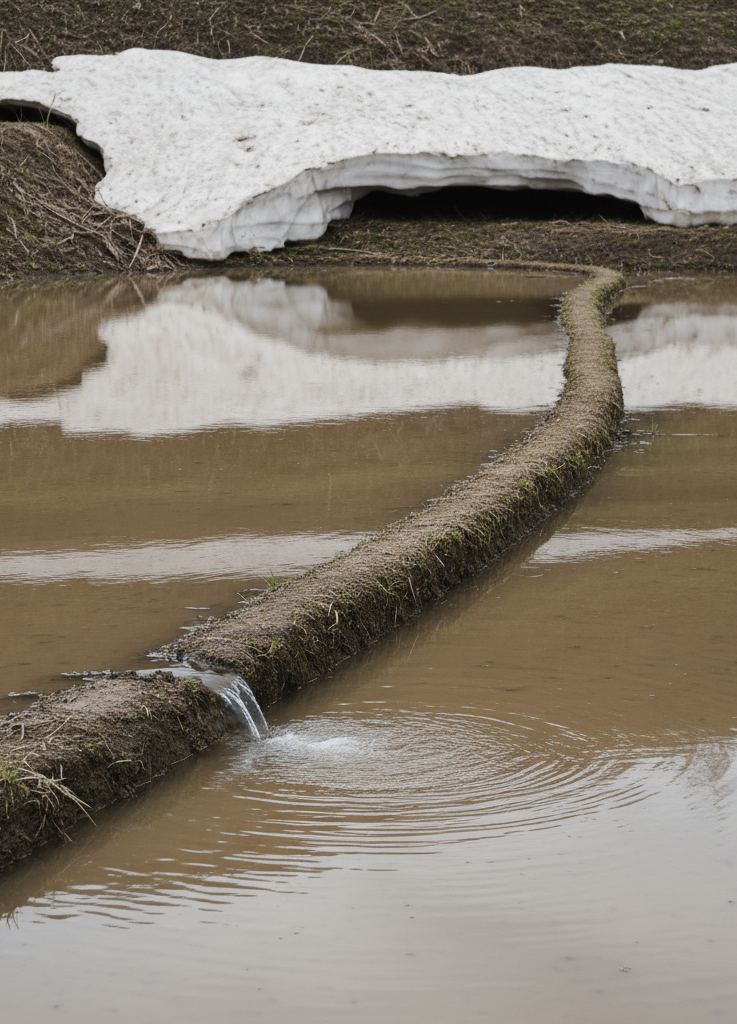
The crop is a short grain cultivar bred in this prefecture in the 1950s and planted on most of these slopes ever since. Seedlings are raised in trays under cover from early April and go into the field at 12 to 15 centimetres, three to five plants to a clump, in rows about 30 centimetres apart. Between the fields run banks of packed earth about 40 centimetres wide. Those banks are the only thing keeping the water in each paddy, and a footprint in the wrong place opens a leak that costs a household a day of repair, which is why nobody stands on them and why the access arrangement matters here more than the viewpoint does.
Because the fields are planted in sequence over about ten days, there is no single morning on which the whole slope looks the same. At any dawn inside the window some paddies are still bare water from the previous afternoon's puddling, some carry the fine green stitching of a field planted yesterday, and the earliest are already fuzzing over. The mix moves up the hill day by day.
The block from 03:15
This is where the trip spends itself. Sunrise on 20 May at this latitude is 04:26, but the ridge opposite holds the sun off the water until nearer 04:55, and the half hour of standing in the dark before that is both the part people come for and the part that is hardest to sit through. Air on the bank reads 8 to 11 degrees Celsius, sometimes 5. The water in the paddies reads 11 to 13. By two in the afternoon the same slope is at 22 to 25 and the surface is doing nothing at all.
What ends the mirror is wind rather than cloud. The surface holds while the air stays under about a metre and a half a second, and the valley wind usually comes up somewhere between seven and half past eight, at which point the paddies go from glass to grey corduroy inside a minute. Cloud only spoils it when it is flat and even; a broken sky puts something in the water worth looking at, and a solid one leaves you a hillside of pale tin.
The other thing about that hour is the noise. Tree frogs start the night the water goes on and do not let up, and at ten to four they are the loudest thing in the valley by a long way. Nobody thinks to mention this in advance and it is worth knowing before you are standing in it.
- 02:40
- Alarm, tea in the farmhouse entry, boots on outside the door.
- 03:15
- Two vehicles out of the village, twenty minutes uphill.
- 03:50
- On the bank. Frogs. Standing water shows before anything else does.
- 04:26
- Sunrise by the calendar; the ridge opposite still has hold of it.
- 04:55
- Sun clears the ridge, and roughly twenty minutes of colour crosses the surface.
- 06:30
- Light flat and even, and the guide moves down the line for the close work.
- 07:30
- Wind up, surface gone, vehicles back down for breakfast at eight.
Five of the six mornings run that way. The sixth is deliberately left open and used as a second attempt if two of the first five came up wrong, which is a call the guide makes the previous evening on the local forecast and not something arranged from FL.
The other twenty two hours
There is no programme between breakfast and dinner, and that is a decision rather than a gap, because the mornings do not survive a full day stacked behind them. Most people sleep from nine until one. What is left is a valley that has been making cloth for a very long time. Tokamachi weaves and dyes, and in late winter it lays finished cloth out flat on the snow to bleach it, which is over by the time you are there, but the grounds and the sheds are still there and one afternoon is arranged around them. Otherwise there are the snowmelt ponds themselves, which repay the walk up, a bath, and the road.
One afternoon is different in kind. A household on the upper slope takes visitors into a small terrace that no machine can reach and puts them to work planting it by hand, in water at about 15 degrees, bent from the waist, for a couple of hours. It is not a demonstration. The field gets planted, and the row you set goes into the water you photograph the following morning.
Dinner is at the farmhouse on five nights and is largely what the valley grows, with rice from the previous autumn off these same fields. The sixth night is left free and is not included, because by that point most people want to eat in town and choose for themselves.
Which nights you can have
Tell Roving Hours which stretch of the second half of May you are able to travel in and how far either side of it you can move. A costed answer against your dates, with the farmhouse held and the dawn programme confirmed by the operating company, comes back inside two to four working days. Nothing is taken from you at that point and nothing is taken from you afterwards either: Roving Hours Bookings LLC takes no payment of any kind. Your bill is written by the firm on the ground in Niigata, under terms that firm sets, and it goes to you directly.
Reaching Japan is your own arrangement, and airfare is not handled here. What the office reserves is the ground: the six nights, the transfer from the station and back, the vehicle and driver at 03:15, and the field access. The train north from Tokyo is not included and runs $50 to $75 each way; the operating company will tell you which service to take once your nights are fixed.
Questions about the fortnight itself, and there are usually several, go to bookings@rovinghours.com. Anything already reserved that needs changing goes to corrections@rovinghours.com or by telephone on +1 (407) 629-3157. The office is at 1350 N. Orange Avenue, Suite 221, Orlando, FL 32789, in Orange, and Roving Hours Bookings LLC is registered in Florida.
Start with the weeks, not the country
This form takes requests every hour of every day, and a person answers within one business day. Nothing here commits you. No figure is charged at this end.