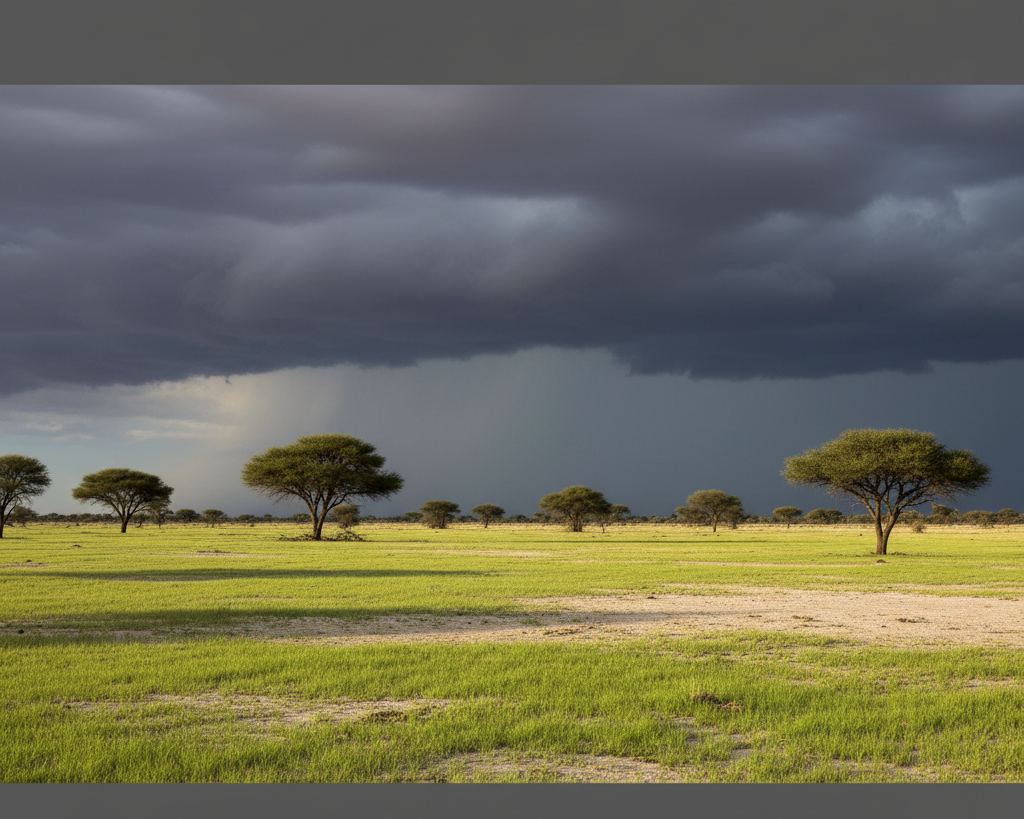
termites off the ground by six, hooves on wet calcrete
Reserve the first rain zebra move in Nyae Nyae and eastern Etosha, late November to January
Roving Hours reserves nine nights for two sharing, five in the pan country of the Nyae Nyae and four on the eastern flats of Etosha, inside a window that runs late November to mid January, from $6,347 per person. What the nine nights are built around is the six or eight days after the first storm, when animals that spent five months tied to a spring walk out onto grass that was not there the week before. Everything else in the arrangement is arranged to put you on that ground while it is happening.
Reserve a windowAn answer is written inside one business day by somebody at this end.
Plains zebra in the east of Namibia spend the back half of the year inside walking distance of water they cannot leave. From July onward the grass out on the open ground is standing dead, down around three percent crude protein, and the herds work in family groups of six or eight close to the springs, out to feed and back to drink and out again. None of that is a move. Then, on some evening between about the tenth of November and the first week of December, cloud that has been stacking since two in the afternoon opens and puts twenty five or forty millimeters on the ground in ninety minutes, and the whole arrangement comes apart at once.
Green shows on calcrete four to seven days after that first fall. New growth carries twelve to fifteen percent protein against the three percent the animals have been living on, and they can find it from a long way off. Inside a week of the first real storm, zebra that were pinned to a spring are twenty kilometers out, then fifty, in some years a hundred and thirty, on ground that had nothing standing on it in October. They travel as columns, a stallion and four or five mares and their foals strung one behind another, and where the new grass is thickest those columns pool into groups of several hundred and now and then into low thousands.
That is what the nine nights are for, and it is why there are nine of them rather than three. Five are spent in the Nyae Nyae, the sand and pan country running east from Grootfontein to the border, where forty odd shallow pans fill within hours of a storm and the tracks between them are the only way through. Four are spent on the eastern flats of Etosha, north and east of the white pan, where the grass comes up early and a column crossing open ground can be watched for an hour without moving the vehicle.
Runs late November to mid January.
The window opens on the first storm heavy enough to put green on calcrete, which in the east falls between about the tenth of November and the first week of December, and it shuts around the middle of January when rain has become general, grass is up everywhere at once, and the herds stop moving as columns because there is no longer anywhere better to walk to.
The opening edge moves by as much as three weeks either side of the first of December from one year to the next, so the office holds your nights against the rainfall the operating company is reading at Tsumkwe and at the eastern gate rather than against a fixed departure date, and a late first storm shifts a booked stay forward instead of cancelling it.
Most of the daylight. Three quarters of the day are programmed, out of camp at 05:45 and running until about 11:15, then out again from 15:15 until the light goes at 19:05, which in the park means being back inside the gate by sunset because that is the rule there.
The unprogrammed quarter is roughly 11:15 to 15:15, when the air is at 34 to 38 degrees Celsius, the zebra are standing head to tail in mopane shade doing nothing worth driving to, and the afternoon cloud is stacking up for the storm that usually breaks between 16:00 and 19:00.
9 nights, from $6,347 per person.
The move happens in most years, the office sells it on that record and on nothing stronger, and in a normal season a nine night stay puts you in front of walking columns on five or six days out of nine. What can take it away is timing: a first storm that comes three weeks late leaves you looking at dry flats and small resident groups, a storm that falls only in the west pulls the grass and the animals away from where you are standing, and neither the operating company nor this office underwrites weather or animal behavior in any form.
- What this office books
- The office books the nine nights of lodging, the road legs from Windhoek up through Grootfontein to Tsumkwe and across to the eastern side of the park, the vehicle and its driver for every programmed block, and the two days out with Ju/'hoansi trackers in the conservancy, and it books no flight, no car hire, no restaurant table and no meal beyond the ones listed below.
- Who books it
- A person booking this wants to be standing on the eastern flats in the fortnight when the columns are actually walking, with somebody who has been reading the same rain gauges since October deciding each morning which piece of new grass to drive to.
- Why somebody picks another window
- Somebody who wants animals stacked four deep at a waterhole in hard light should take a dry month instead, because rainwater is lying in every hollow in these weeks and nothing has to come to a spring to drink.
- In the figure
- Five nights in a tented camp of six units on the edge of the sand country and four nights in a room at a small rest camp inside the eastern part of the park, two sharing; all breakfasts, and dinner on every one of the nine nights; packed food and cold water carried in the vehicle for the morning and afternoon blocks; road transfer from Windhoek through Grootfontein to Tsumkwe, the cross leg from Tsumkwe to the eastern gate, and the return leg to Windhoek; a driver who has worked these two areas through six seasons and who takes the rain readings himself each morning; eighteen programmed blocks in a vehicle taking seven, with the ground chosen that day from where the grass came up; two days walking and sitting with Ju/'hoansi trackers from the conservancy, arranged and paid through the conservancy office; the conservancy levy and the park entry permits, obtained and paid on your behalf by the operating company; a written note each evening of the previous day's rainfall, grass height and where the largest groups were standing; all local taxes and the operating company's booking administration.
- Not in the figure
- Round trip flight from Orlando into Namibia, usually $1,180 to $2,240 depending on the week; lunches on the two long road days, $8 to $18 each; the four dinners you may prefer to take away from camp, $11 to $26 each; all drinks; single occupancy across the nine nights, $735; a vehicle held for the two of you rather than shared, $480 for the stay; laundry, $5 to $11 a load; camera equipment, long lenses and spare batteries; gratuities to the driver and to the trackers, entirely your own call; anything you add once you are on the ground, billed to you by the operating company on its own paper.
- Who this window will not suit
- You will be awake at 05:15 for nine mornings running, on a hard seat over corrugated gravel for several hours a day, in air that sits at 36 degrees Celsius before the rain arrives and turns close and wet afterward. The middle of every day is empty because the animals do nothing in it, Tsumkwe has no evening to speak of, and if you dislike four unfilled hours in heat you will dislike a large part of this stay. Sand tracks in the conservancy go soft after a storm and a stuck vehicle can cost an hour of digging with everybody out in it. And the honest end of it is that rain is the whole mechanism here: if the first storm holds off, the grass does not come, the columns do not form, and you will have spent nine nights in a quiet corner of Namibia looking at small groups of zebra standing near water.
A starting figure for two people sharing one room. Pricing the exact window you pick runs two to four working days, because the company working those dates answers first. No air ticket is ever folded in.
The first storm and the six days after it
The rain here does not arrive as a season. It arrives as one afternoon. Cloud builds from about 14:00, the light goes brown, wind comes ahead of it hard enough to take the top off a pan, and then the storm sits over ten or fifteen kilometers of ground for an hour and a half and moves on. Twenty millimeters is enough to start everything. Forty is a proper one.
What happens that same evening is easier to notice than the grass. Winged termites come off the ground in hundreds of thousands within two hours of the wetting, and every bird and jackal in the district works them until dark. Frogs that have been buried since April are calling from a pan by the second night, loud enough at fifty meters to make conversation difficult. Neither of those is why you came, but both are how you know the clock has started.
The grass is four to seven days behind the storm. First a haze of green that you can only see at a low sun angle, then a definite flush, then ankle height by about the third week. The zebra do not wait for ankle height. Groups start pulling away from water two or three days after the first fall, feeling their way out along the flats, and the first proper columns are usually on the move inside a week. Mares drop foals through the same weeks, and by late December most groups you sit with have foals in them, brown rather than black on the stripes and standing shorter than the mother's belly.
Why the window shuts in the middle of January
The window closes for the opposite reason to the one people expect. It does not close because the rain stops. It closes because the rain becomes ordinary.
By the second week of January storms have gone through most of the eastern half of the country several times over, and grass of a usable quality is up on the flats, in the mopane, in the sand country and on the pan margins all at once. When that happens there is no longer anywhere better to walk to, and animals that were moving in columns of four hundred break back into family groups spread thinly over a very large area. They are still there. They are simply no longer doing the thing this trip is sold on.
Two practical edges arrive at the same time. Tracks in the conservancy soften, the clay margins of the bigger pans hold water, and there are days in mid January when a vehicle can reach half the pans it could reach in November. The operating company's last dated departure is usually the second week of January for that reason, set in October and then corrected against what has actually fallen. A costed answer against particular dates comes back from this office inside two to four working days, and it takes that long precisely because somebody has to check the current rain readings before a figure means anything.
- Third week of November
- heat near its peak at 38 degrees, pans dry, herds still tied to springs
- Last week of November
- first storms usually break in the east, termites fly the same evening
- First week of December
- green haze on calcrete, first columns pulling away from water
- Second week of December
- pans holding water, frogs calling, mares dropping foals
- Late December
- grass at ankle height, largest groups of the season on the eastern flats
- First week of January
- rain general, animals starting to spread out, sand tracks going soft
- Second week of January
- the move has stopped being a move, and the window closes with it
- Any day in the window
- three quarters of the day programmed, the middle four hours are not
Three quarters of the day, and the four hours nobody uses
Coffee at 05:15 and out at 05:45, which in the park half of the trip means sitting at the gate as it opens. The first block runs until about 11:15 and it is the one that matters, because the columns walk in the cool and because low light across flat grass shows you movement two kilometers off. A morning covers around 70 kilometers, no more: the limit inside the park is 60 an hour and the point is to stop.
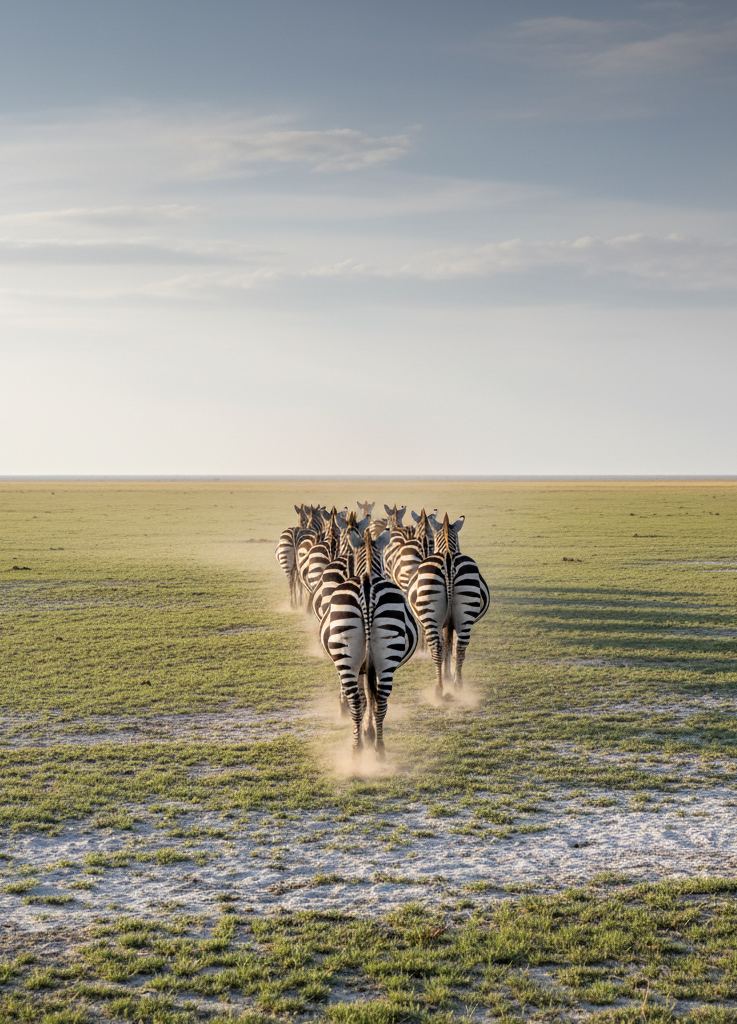
Back out at 15:15, and the afternoon block runs to 19:05 in the conservancy or to sunset at the gate in the park. The afternoon is the one that gets rained on, and being rained on is not a failure of the day. Standing storms move slowly enough that a driver can put the vehicle where the edge of the cell has just passed, on grass that is wet and steaming with animals grazing hard on it, which is the hour a driver will rearrange an afternoon to reach.
The four hours in the middle belong to you and there is no way to make them productive. Air at 34 to 38 degrees, zebra standing motionless in whatever shade they can find, and cloud building overhead. The camp has shade, cold water and a book, and on the two tracker days the middle of the day goes under a tree while somebody explains what they dug up that morning. The night is not programmed at all. Nine nights of this trip end with dinner, and the one thing anybody does after dark is listen to the pans.
Grass, water, and what a poor year looks like
It is worth being plain about the failure case. If the first storm holds off until the third week of December, and that happens, the grass is three weeks behind and the herds are still working out of the springs when you arrive. You would still see zebra, in twos and sixes rather than in columns, along with elephant, giraffe, oryx and whatever else is tied to the same water. It would be a quiet nine nights in an empty part of the country, and not the thing described here. Nature is not underwritten here by anybody, not by the company running your dates and not by this office, and the nine night length is the only hedge available: it puts you on the ground across enough days that a slow start does not take the whole stay with it.
Nothing described above is property of this office. The tents, the room at the eastern gate, the vehicle, the cold box and the rain gauge belong to other people, and the company running your dates writes your invoice itself, on its own paper and under terms it set, and sends it to you directly. The air ticket into the country is your own piece of work and does not sit anywhere inside the figure quoted here. Where the trip needs a park entry permit or a levy payable to the conservancy, the operating company obtains and pays both as part of running the days.
To start, send the weeks you can travel in, how many of you there are, and whether you want the conservancy half first or last. Roving Hours Bookings LLC answers from Orlando, Orange, Florida. Call +1 (407) 629-3157 or write to bookings@rovinghours.com, and anything that needs fixing on a quote already sent should go to corrections@rovinghours.com. The office address is 1350 N. Orange Avenue, Suite 221, Orlando, FL 32789.
Start with the weeks, not the country
This form takes requests every hour of every day, and a person answers within one business day. Nothing here commits you. No figure is charged at this end.