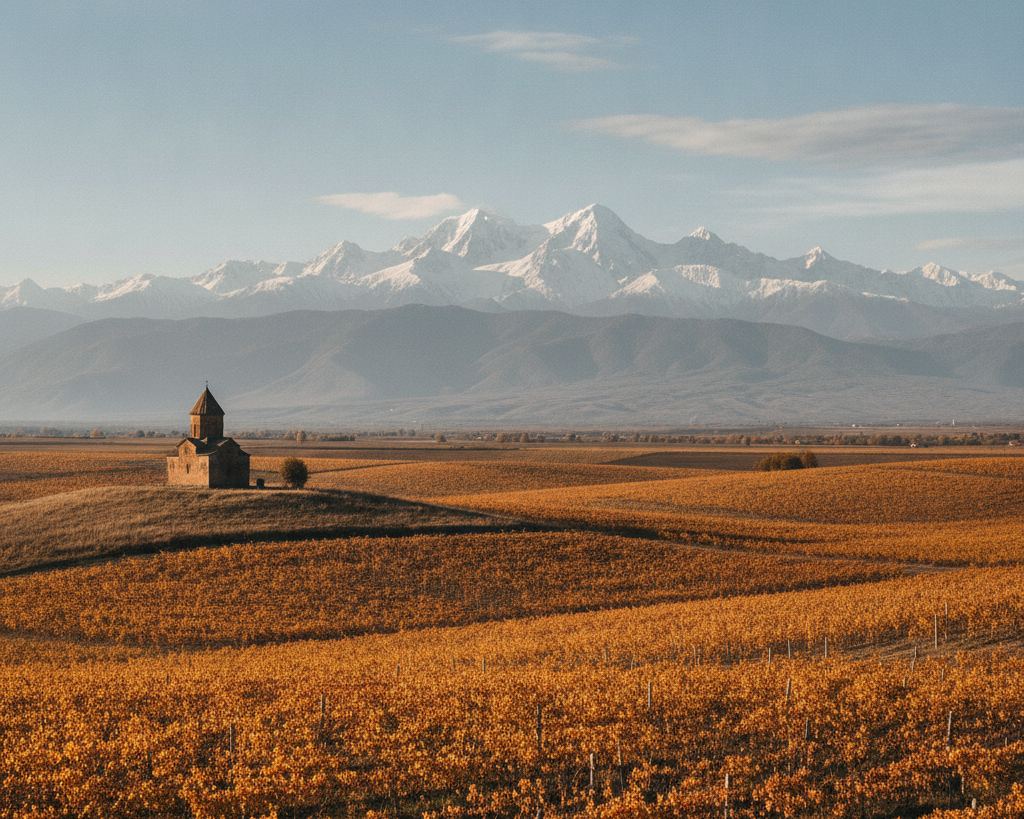
dew to the knee, sticky hands, walnuts on a string
Reserve a harvest trip in Kakheti for the rtveli, mid September to mid October
Nine nights in the Alazani valley, held inside the mid September to mid October picking window, from $4,109 per person on two sharing. You cut with a household that works two to five hectares, carry your own crates out to the track, and stay until the fruit is weighed and under clay. For about four weeks the villages here are empty in the daytime because everybody who lives in them is out between the rows.
Reserve a windowAn answer is written inside one business day by somebody at this end.
To reserve a harvest trip in Kakheti is to book a set of dates that belong to the fruit rather than to you. Rtveli is the word for the picking, and in the eastern Georgian valleys it is not staged for visitors: for about four weeks every household with rows behind the house stops doing whatever it normally does, and the grapes come off before the weather turns them. What Roving Hours holds is nine nights inside that stretch, from $4,109 per person on two sharing, with your hands in the work rather than at the edge of it.
The window opens on the flat ground and closes on the slopes. Rkatsiteli and Mtsvane, the white varieties that fill most of what is planted around Telavi, reach their sugar first, generally in the week of September 15. Saperavi, the black grape behind everything red in this district, hangs on three to four weeks longer, and the last of it leaves the terraces above 700 meters somewhere between October 12 and October 20. Take the front of the window and you cut white fruit in shirtsleeves with the valley at 78F in the afternoon. Take the back of it and you cut black fruit in a jacket, with the first snow of the year showing on the range to the north.
Work begins at first light because fruit that heats up in the crate has already started working on itself by the time it reaches the yard. You are between the rows by about 06:50 with dew heavy enough to soak you to the thigh, the loads go down to the marani through the middle of the day, and the crushing and the filling of the vessels run on until the weighing finishes in the late afternoon. That accounts for most of the daylight, and it is what the mark on the card below stands for.
Runs September 16 to October 19.
The window opens when the white fruit on the valley floor reaches its sugar, usually in the week of September 15, and it shuts when the last Saperavi comes off the terraces above 700 meters and the presses are scrubbed out, which lands between October 12 and October 20.
A hot August pulls the start forward by up to ten days and a wet one pushes it back about as far, so the office holds a provisional pair of dates from July, confirms them with the households in the last week of August, and moves your whole nine nights together rather than letting the trip run short at one end.
Most of the daylight. Cutting is programmed from about 06:50 onward, while the rows are still cold enough that the bunches come off firm, and runs through the crushing and the filling of the vessels to the weigh in, which is normally finished by 17:00.
After the weighing the day belongs to you: dinner is at the house you are staying in, nothing is scheduled into the evening, and nobody is driven anywhere after dark.
9 nights, from $4,109 per person.
The harvest is about as dependable as anything sold on this site, because fruit that has reached its sugar has to come off the vine whatever the sky does, so what actually moves is the date rather than the event. Two days of steady rain will stop the rows outright, and if that falls inside your nine nights you will spend it under the marani roof on vessels, lids and the pressing that has backed up, which is real work but not the work you booked; weather is underwritten by nobody, the figure does not drop because of it, and the day is not added back at the far end.
- What this office books
- The office reserves the nine nights of rooms, four days cutting and two days in the marani with the host households, the van and its driver inside Kakheti and the road transfer from the capital in both directions, and it reserves nothing whatever about your flight, your two open dinners or anything you decide to carry home.
- Who books it
- A person booking this wants to be inside a working harvest with shears in their hand and a crate of their own on the track, rather than beside one with a glass.
- Why somebody picks another window
- Anybody who wants long unhurried afternoons and a valley with room in it should take a different window, because across these four weeks every household is short of hands and the day is built around the crates rather than around the visitor.
- In the figure
- Nine nights in family rooms in two villages and one small guesthouse above the valley, two people sharing; every breakfast, taken standing in the yard before six thirty on picking days; six lunches carried out to the rows or eaten at the press; five evening tables with the host households; four full days cutting, with shears, gloves and crates handed out at the shed; two days in the marani on crushing, pressing and filling; the van and its driver for all nine days, seating eight; a guide from the district who stays with the group the whole time and speaks Georgian, Russian and English; the road transfer from the capital over the pass and back, about two hours each way; entry to the eleventh century cathedral north of Telavi and to the district museum; the permit the operating company holds to bring a group into a working marani during the picking weeks; every local charge on the rooms.
- Not in the figure
- The round trip flight you buy for yourself, Orlando to Tbilisi, running about $980 to $1,740 across this window depending on stops and how far ahead you book; a night in the capital at either end if your arrival time needs one, $70 to $160 a room; two dinners left open, $14 to $38 a head; wine carried home from the households, $9 to $34 a bottle and $60 to $130 a case; the taxi between the capital airport and a city hotel, $30 to $45 each way; laundry at the guesthouse, $8 to $15 a load; a phone data package for the nine days, $12 to $25; boots and long sleeves for the rows, which you bring or buy in Telavi for $35 to $90; what you leave with the picking households, entirely your decision, with $40 to $90 across the week being usual; single occupancy, $610 for the nine nights.
- Who this window will not suit
- This is not a tasting week and nothing about it is arranged for comfort. You are on your feet from before seven, bent or kneeling under vines trained low, wet to the thigh with dew and then working in the afternoon heat, and your hands will be sticky and cut by the second day. A full crate runs near 18 kilos and you carry it out to the track yourself. If a day of manual work alongside people who speak no English, followed by a table that goes on for four hours and cannot be left early without causing offense, sounds like something to sit through rather than something to do, book a different window.
A starting figure for two people sharing one room. Pricing the exact window you pick runs two to four working days, because the company working those dates answers first. No air ticket is ever folded in.
From the shears to the sealed vessel
A household in this valley works two to five hectares, which is five to twelve acres, and it cannot get that off the vine alone. That is the entire reason two strangers with two pairs of hands are wanted here and are put to work about ten minutes after arriving. The vines are trained low, so you cut kneeling or bent, into a crate that runs near 18 kilos when it is full and then has to be carried out to the track. Nobody counts what you bring in. Somebody will, once and without a word about it, point out the second smaller bunch you left hidden behind a leaf.
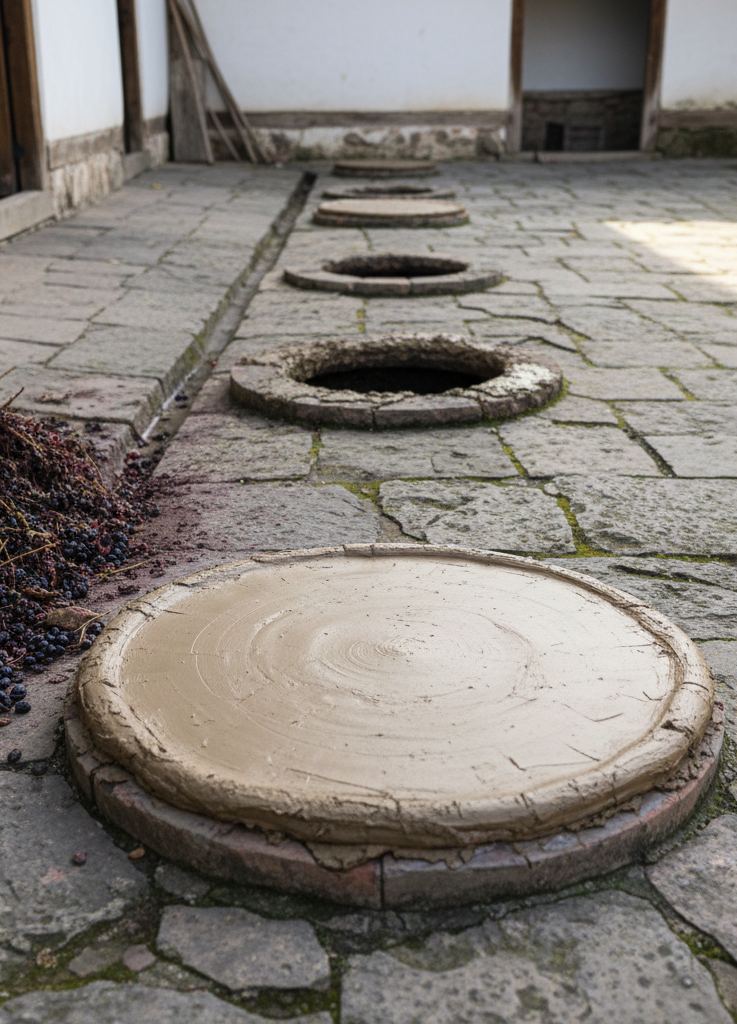
Fruit goes into a satsnakheli, a press hollowed out of a single trunk, and is worked with bare feet. There are electric crushers in the district and two of the households on this itinerary own one, but through the picking weeks the log gets used, because it washes out faster and because the whole yard can stand around it. Juice, skins, stalks and pips run down together into a qvevri, a clay vessel of anywhere between 300 and 2,000 liters set to its neck in the floor of the marani, where the ground holds the ferment near 14C whatever the yard outside is doing. The lid goes on with clay and river sand and stays there into the spring.
By the second afternoon somebody in the house will be boiling juice down with flour into a thick brown paste and dipping strings of shelled walnuts through it, six or seven passes each, then hanging them in a doorway to skin over for a fortnight. What the press leaves behind is kept for distilling in November, long after you have flown home. Nothing you touch across the nine days belongs to Roving Hours Bookings LLC: not the rooms, not the van, not the log, not the vessel in the floor.
The valley floor, the wall above it, and the light going
Telavi stands at about 550 meters on the southern shoulder of the Gombori range and looks north over 30 to 40 kilometers of near continuous vineyard on the Alazani floor. The main Caucasus wall closes that view at more than 3,000 meters and takes its first real snow in the second half of October, which is the plainest signal in the valley that the picking is nearly finished. On September 18 the sun comes up at 06:45 and goes down at 18:59. By October 15 it is 07:15 and 18:13. The working day sheds about three quarters of an hour a week across the window, and on the last dates the final crate goes in under a low orange light with the temperature dropping as it does.
Afternoons run near 78F in the third week of September and near 68F in the middle of October, with 52F before breakfast and the rows wet until eight. The road in from the capital crosses the Gombori Pass at about 1,620 meters, takes a little over two hours and is open throughout this window; snow shuts it, but snow on that pass is a January matter. Two of the villages on this itinerary have one shop apiece, and each shuts when the family who keep it go out to their own rows. The eleventh century cathedral north of Telavi closes to visitors during services, which do not run to a timetable you can plan around, and the district museum is shut on Mondays.
- September 16 to 22
- White fruit on the valley floor, warm afternoons, the first long table of the year.
- September 23 to 29
- Whites at full pace, every yard working, the longest daylight left in the window.
- September 30 to October 6
- Whites finishing, first Saperavi cut on the lower slopes, mornings noticeably colder.
- October 7 to 13
- Saperavi across the district, dew in the rows until nine, jackets on until eleven.
- October 14 to 19
- The last fruit off the high terraces, snow showing on the range, presses being scrubbed out.
- A wet forty eight hours
- The rows stop, the day moves indoors onto vessels, lids and the pressing that has piled up.
- After October 20
- Bare rows, sealed clay, and nothing left in the valley for this trip to be built on.
What two days of rain does to a picking week
The harvest itself is dependable in a way that very little else sold here is, because fruit that has reached its sugar has to come off the vine whatever the sky does. What moves is the date, not the event. Rain is the one thing that stops the rows outright: a wet spell of two days is ordinary in early October, and if one lands inside your nine nights you will spend it under the marani roof on vessels, lids and the pressing that has backed up. That is real work, but it is not the work you came for. Weather is underwritten by nobody, the figure does not fall because it rained on you, and the lost day is not made up at the far end.
The other honest thing to say concerns language. In two of the four houses there is nobody under sixty at home during the day, and no English at all is spoken between the rows. The guide is from the district and stays with the group for all nine days, so you are never left standing in a yard wondering what is happening, but a good part of every afternoon runs on gesture, and the evening table goes long whether or not you can follow what is being said across it.
Nine nights, and who sends the bill
Roving Hours reserves the nine nights of rooms, the four cutting days and two marani days with the host households, the van and driver inside Kakheti, and the road transfer from the capital and back. It reserves nothing at all about your flight: that one is yours to buy, no air ticket is sold at this office, and no seat is inside the figure above. The company that actually runs those days sends its invoice straight to you, in its own name and on its own terms, and this office collects nothing from you at any stage, in any form.
Pricing one exact pair of dates needs two to four working days here, because the households have to be asked before a figure goes out and during rtveli nobody answers a telephone until after dark. Tell us which end of the window you want, how far your dates can move if the fruit comes early, and whether you would rather be in the white or the black. What comes back is an itemized figure with the nights, the cutting days, the marani days and the transfers listed separately, so you can see what each part of the nine days costs.
Roving Hours Bookings LLC works from 1350 N. Orange Avenue, Suite 221 in Orlando, FL 32789, which is Orange, Florida. Send your dates to bookings@rovinghours.com, or reach an agent on +1 (407) 629-3157 if you would rather talk the window through out loud. Anything on this page that has gone stale should go to corrections@rovinghours.com, and it will be checked against the operating company before a word of it is changed.
Start with the weeks, not the country
This form takes requests every hour of every day, and a person answers within one business day. Nothing here commits you. No figure is charged at this end.