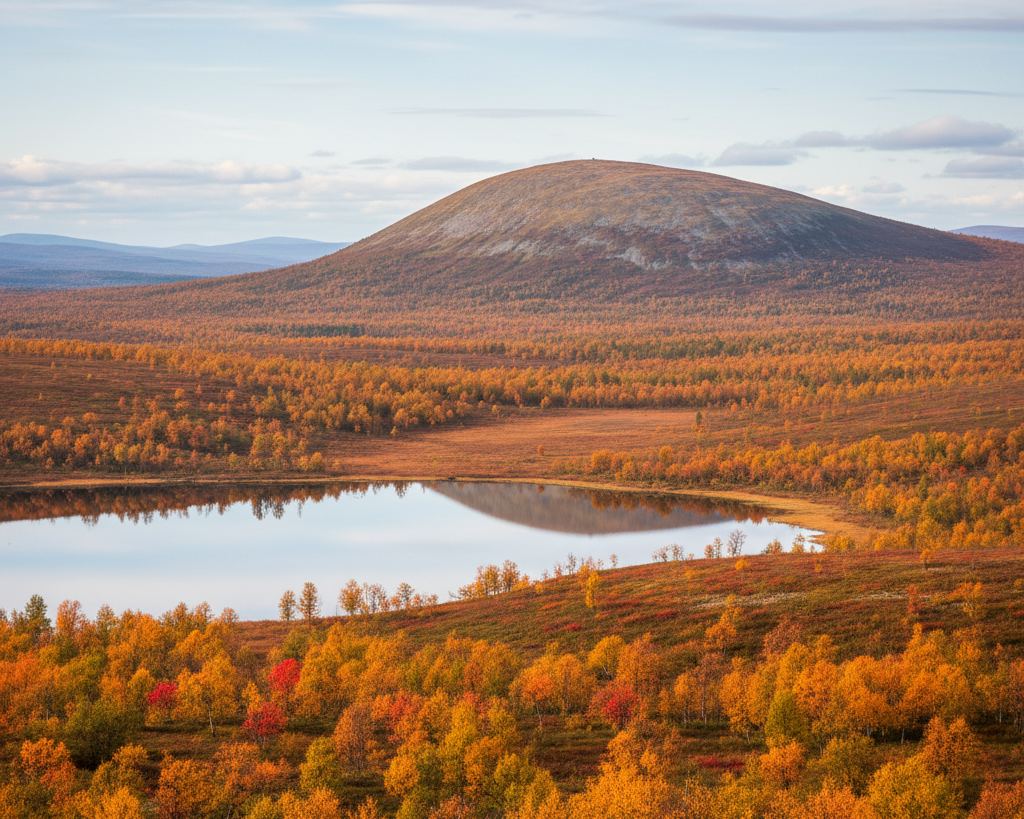
red ground under a low sun, frost on the boardwalk by six
Reserve a ruska trip in northern Lapland for the first three weeks of September
Seven nights in a six room timber house on the lake shore north of Inari, for dates of your choosing between September 1 and September 21, from $3,784 per person on two sharing. Those three weeks are the ruska, when frost turns the dwarf birch and the bilberry ground scarlet, the mountain birch yellow, and then a wet gale takes all of it down. Roving Hours takes the dates you name, holds the room and the driver on them, and asks the company that works these fells for a written figure.
Reserve a windowAn answer is written inside one business day by somebody at this end.
Ruska is the word northern Finland uses for the two or three weeks in which the ground colors and then goes. It is not really a tree event. The mountain birch turns yellow and the aspen orange, but the thing worth crossing an ocean for is underfoot: dwarf birch going scarlet, bilberry red between the stones, bog bilberry purple, cloudberry leaf nearly black, all of it spread across open fell in one continuous sheet you can walk on for an afternoon. To book a ruska trip in northern Lapland is to book three weeks of calendar and then find out which days inside them the color uses.
Frost sets it. Once the nights drop to minus two and minus five, with the day shedding nine minutes at a time, the plants stop making chlorophyll and draw back what is left, and the red and yellow that sat underneath all summer are uncovered. At 68 degrees north the handover is fast: a birch stand goes from green to fully yellow in four days, and the low ground runs about a week behind the tops, so the season comes downhill, color on Otsamo while the shore is still in summer, then both, then only the shore.
What you are reserving is seven nights in a six room timber house north of Inari, with a vehicle, a driver, a guide and one programmed evening on each of the seven days. The dates inside the window are yours to pick. Putting a week to the operator and getting a real number back runs two to four working days here, because the family in that house answers by hand, not out of a system.
Runs September 1 to September 21.
The color is set by the first run of nights below freezing, which the far north ordinarily gets in the last days of August, and the season ends when a gale with rain in it strips the mountain birch bare in about two days.
Peak color lands a week early or a week late depending on how cold August was, so the office keeps the same three weeks every year, reports what the ground is actually doing in the fortnight before you fly, and shifts you inside the window if a room can be shifted.
A morning or an evening. The evening is what gets programmed, running from three hours before sunset until civil twilight shuts, which is 17:55 to 21:55 on the earliest departures and 16:15 to 20:05 on the last.
The rest of the day is a slow start behind the frost, the drive to wherever the guide has decided to stand that night, an hour or two on foot at your own speed, and one table at dinner well after dark.
7 nights, from $3,784 per person.
The leaves turn every year, so the season is close to certain; what moves is the date, and in a warm wet autumn the peak can land a week after your last night or a week before your first. Two more things belong to nobody: in outbreak years the autumnal moth eats the mountain birch out in July and leaves gray stands where the yellow should be, and the aurora, which these equinox weeks are good for, arrives when it arrives and is underwritten by no one on this trip.
- What this office books
- What Roving Hours books is the house for seven nights, the road up from Ivalo and back down, a vehicle with a driver, and the guide who decides where each evening is spent; airfare, the hour on the water and everything you spend in the village all sit outside that.
- Who books it
- Somebody reserving this wants to stand on open fell in the last hour of light with the ground under them red to the horizon, after the mosquitoes have finished and before the snow arrives.
- Why somebody picks another window
- If what you want is the reindeer round ups, or the first snow lying on colored ground, both of those belong to the last days of September and the first of October, by which time the birch up here is bare and this is the wrong reservation.
- In the figure
- Seven nights in a six room timber house on the lake shore, twin or double with private bathroom; breakfast put out late every morning and left standing, because nothing here moves early; a hot dinner on all seven nights, eaten at one table when you come in from the fell; road transfer from Ivalo and back, about forty minutes each way with reindeer on the carriageway; a vehicle and a driver for the whole week; a guide who fixes each evening position the night before, on the forecast and on where the color has reached; the programmed evening on all seven days, at a different place each time; a lakeside sauna heated on five of the seven evenings after you are back; rubber boots and a waterproof outer layer in your size, if flying with your own is not worth the bag space; a sheet printed on the day you arrive giving sunrise, sunset and the end of civil twilight for every date you are there; a heated cupboard for wet boots and coats and a washing machine in the hall.
- Not in the figure
- Airfare from Orlando, $860 to $1,510 round trip across this window, which is yours to buy and is not ticketed at this end; the hour on the water out to the rock island in the lake, which the firm running that boat holds under its own licence and bills you for directly, $40 to $65 per person; lunch on all seven days, $12 to $24 a head at the shop or the one place in the village that cooks; beer or wine with dinner, $8 to $14 a glass; a room to yourself instead of sharing, $505 for the week; a second guide if your party wants to split up in the evening, $290 a day; a smoke sauna evening at a neighboring house, $60 to $90 per person; canoe hire on the river, $35 to $55 a day; an extra night near Ivalo when your return leaves at first light, $110 to $170; handwork bought from the workshops in the village, $30 to $340.
- Who this window will not suit
- Do not reserve this if you need to be indoors by seven, because the whole of what you came for happens between six and ten at night and there is no earlier version of it. The ground is wet, since the bogs do not dry out in September: most positions involve twenty to forty minutes of walking on duckboard or soaked reindeer moss, and you will come in with cold feet every evening of the seven. Nobody can tell you nine months out which week the color will peak, so a party that will be angry at yellow green birch and a bare fell top should not fix dates that far ahead. And there is very little else here: one shop, no evening to speak of once dinner is over, and a hundred kilometers between fuel pumps.
A starting figure for two people sharing one room. Pricing the exact window you pick runs two to four working days, because the company working those dates answers first. No air ticket is ever folded in.
The frost, the leaf, and the order it happens in
The order holds even when the timing does not. Dwarf birch on exposed ground goes first, usually in the last days of August at this latitude, and it goes red rather than yellow. Bilberry follows inside a week and is what makes the middle distance look painted. Mountain birch, the crooked timberline tree covering most of the fell sides, lags three or four days behind the ground beneath it and turns clean yellow. Aspen and rowan are last and scattered, so they read as single orange marks rather than a band, and by the time the aspen is out the exposed tops have often dropped.
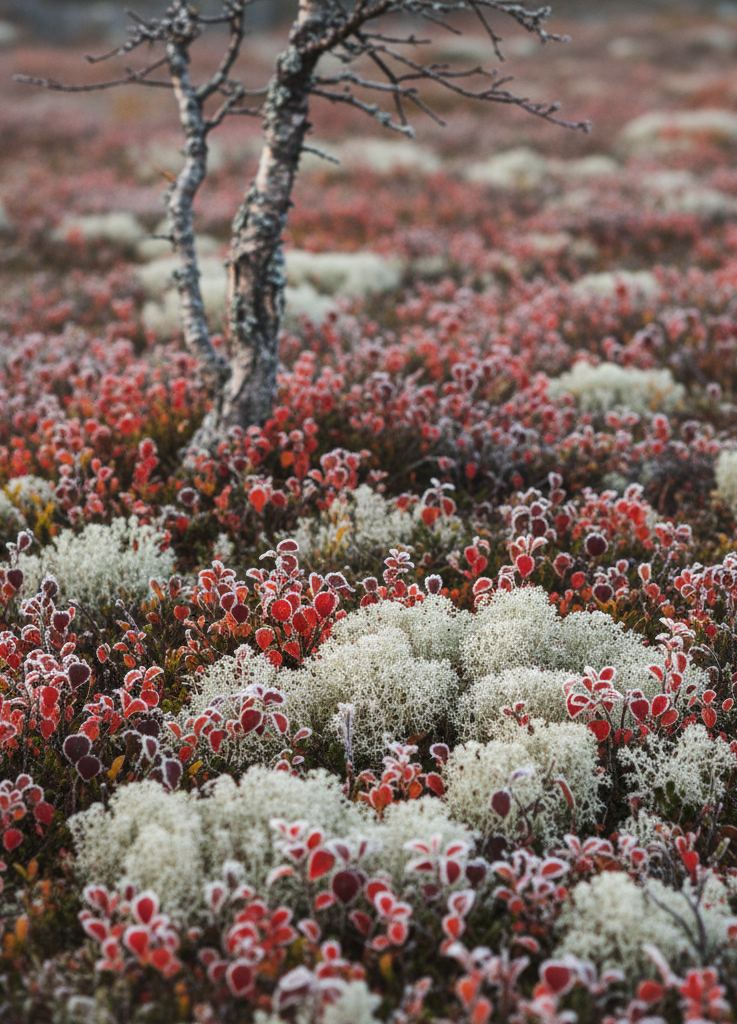
Two hard frosts in a row move the whole sequence forward by days. A week of wet southwesterly air with nights at plus four holds it where it is and dulls the red, which is the commonest way a ruska week disappoints: not an absence of color but flat color, yellow green birch and rust instead of scarlet. Nobody sells weather. What can be done is to tell you in the fortnight beforehand what the ground is genuinely doing, since the guide is out in it nightly and will say so whether or not it suits the booking.
The evening, and what the other fifteen hours are
The sun never gets high here in September. On the 10th it tops out around 26 degrees above the horizon and on the 21st around 21, and through the last hour before it sets it is under seven. Light arriving at that angle passes through a dwarf birch leaf instead of bouncing off it, which is why the block sits where it does rather than at midday. You are driven out, you walk between ten minutes and forty, and you stay in one position while the light falls through the ground in front of you.
Positions change with the wind and with what has already turned. A bog boardwalk with standing water both sides, because the color arrives twice there, once on the moss and once in the water. The shoulder of a fell above the timberline at 350 meters, where dwarf birch and lichen carry the slope red and nothing stands up to interrupt it. The north shore of a small lake, taken because the light comes across the water straight at you. A river bend with mountain birch leaning off the cut bank. Two of the seven are within 200 meters of the vehicle, since standing still at 4 °C in wind is as much as most people want in a night.
The other fifteen hours are not filler, but nor are they programmed. Breakfast is late because dinner was late. Frost sits on the boardwalk outside the door until about ten in the first week of the window and nearly eleven in the third. Middays go on the road, on the shop, on a walk of your own, or on nothing. Dinner is eaten when you come in, between half past nine and half past ten at the front of the window and nearer half past eight by the end, at one table with whatever the house has cooked.
- September 1 to 4
- fell tops already turning while the lake shore is still green, sun up 05:16 and down 20:57, afternoons 8 to 12 °C
- September 5 to 9
- color into the middle ground, dwarf birch leading and mountain birch three or four days behind, hard frost most nights
- September 10 to 13
- the usual peak in this part of Lapland, colored from the top of Otsamo down to the water, ground reading red rather than yellow at a distance
- September 14 to 17
- color complete but past its best on the tops, birch dropping wherever wind reaches it, night frosts of minus four common
- September 18 to 21
- the shore holds the last of it, sun up 06:47 and down 19:16, sleet above 300 meters, first stands going bare
- any clear night from the 5th
- full dark by half past ten early in the window and half past eight at the end, which is when the aurora question starts and where it stays
- whenever it comes
- one gale with rain behind it takes the birch bare in two days and ends the season wherever that falls
Inari, the lake and the road north
Inari village sits at 68.9 degrees north on the western shore of a lake of roughly 1,040 square kilometers, with more than 3,000 islands in it and 92 meters of water at the deepest point. It is 40 kilometers up the road from Ivalo, half an hour in theory and longer in practice, because reindeer stand in the carriageway at dusk and do not move for a horn. Mountain birch gives out between 300 and 350 meters, so from the house on the shore you can be above the treeline inside an hour of walking, and Otsamo at 417 meters carries bare rock and lichen on top with the colored band wrapped around its middle.
The village itself is one shop on short hours and shut on Sunday, a fuel pump, a museum, and two workshops open into September. Thirty kilometers north at Kaamanen the road forks, and beyond it a hundred kilometers run toward Utsjoki with nothing on them to buy, worth knowing if you mean to use the middle of the day for driving. The boat that goes out to the rock island in the lake, a Sami sacred place, stops for the season somewhere around the middle of the month depending on what the water is doing; the firm operating that boat holds the passage under its own licence and sends you its own bill for it.
September takes two things out of the place: the mosquitoes, finished by the end of August and not returning, which alters what standing still on a bog for two hours is like, and the summer walkers, who go with them. What comes instead is cold, 8 to 12 °C in the afternoons early on and 3 to 7 °C by the end, with frost every clear night and sleet above 300 meters after the 18th.
What is reserved here, and what is not
Not one bed, wheel or stove named above is owned by this agency. Roving Hours Bookings LLC works under the name Roving Hours from 1350 N. Orange Avenue, Suite 221, Orlando, 32789, in Orange, Florida, and what happens there is that your dates go to the company that works these fells in September, the detail is argued out in writing, and a figure comes back for you to read before agreeing. That company invoices you on its own paper, on its own terms, when it chooses. Whatever you pay, you pay to them, and nothing is collected at this end at any stage.
Getting yourself to Finland is on you, and no seat in the air is sold or ticketed here. The transfer between Ivalo and the house is booked here, both directions, and sits inside the figure above. If you want the hour on the water, say so and it will be arranged, but the passage belongs to the operator running it and the charge reaches you from them.
Tell Roving Hours the stretch of the three weeks that works at your end, and how much either way you are free to shift. The figure for the dates you name is built and sent back within two to four working days, since the house, the driver and the guide all answer against those nights before a number means anything. Questions before you commit go to +1 (407) 629-3157 or in writing to bookings@rovinghours.com. If anything here has drifted out of line with what you find on the ground, send it to corrections@rovinghours.com and it will be checked.
Start with the weeks, not the country
This form takes requests every hour of every day, and a person answers within one business day. Nothing here commits you. No figure is charged at this end.