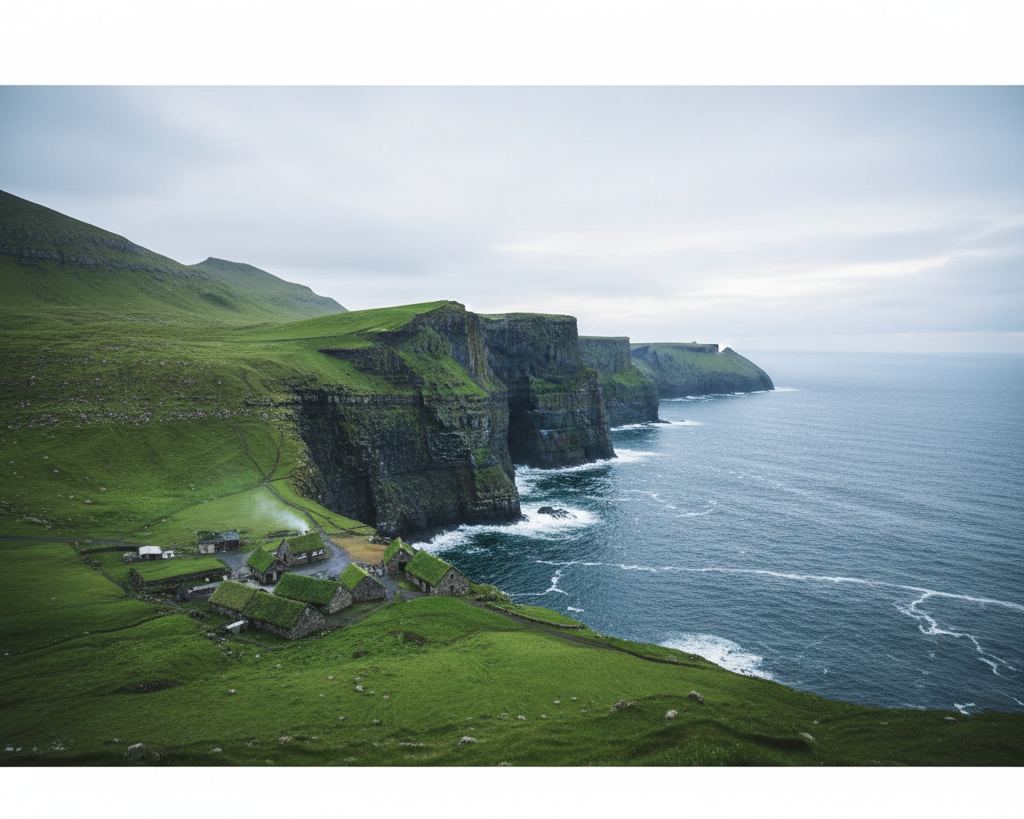
guillemots on the ledge at one in the morning, no headlamp
Reserve a Faroe Islands midnight light trip, late May to mid July
Seven nights on two islands with one hour written into every one of them, from $4,443 per person on two sharing, on dates between late May and the third week of July. The hour is the one either side of solar midnight, when the sun at this latitude sits about four degrees under the horizon and the cliff faces keep their colour instead of going to silhouette. People take it because there is nowhere else you can watch a seabird ledge work at one in the morning and still read the numbers on your own watch.
Reserve a windowAn answer is written inside one business day by somebody at this end.
A Faroe Islands midnight light trip is a reservation built around one hour of the night rather than around a place. The hour is the one either side of solar midnight, which in Torshavn falls at about 01:27 while the clocks are forward. Seven nights, two islands, and that hour is written into every one of them. What the figure buys you is being somewhere with an open northern horizon at the moment the sun is at its lowest, and between late May and the third week of July that low point at 62 degrees north sits roughly four degrees under the line.
Four degrees under is the entire reason for the dates. It is shallow enough that the sky never leaves civil twilight, which in plain terms means you can read a paper map on a cliff top at one in the morning without a lamp, and the rock keeps its colour instead of flattening into a black shape against a grey one. The colonies do not settle either. Guillemots on a wide ledge carry on shuffling, calling and swapping places through the whole hour, which they do not do anywhere further south where the dark actually arrives.
This is not midnight sun, and it is worth being straight about that before you reserve anything. Midnight sun needs 66.5 degrees north and these islands are four and a half degrees short of it. The sun does go down. It goes down shallowly, stays just under, and comes back up a little to the east of where it went, and the whole four hours in between is one long even light with no shadow direction you can rely on.
Runs May 22 to July 18.
It opens when the sun stops falling more than six degrees under the horizon at solar midnight, which at 62 degrees north happens around May 21, and it shuts in the third week of July when the sun starts dropping past that line again and the auk ledges begin to thin out.
The astronomy moves by a day at most from one year to the next, so what actually shifts is the sea and the birds: a cold spring puts the ledges about a week behind, and the office moves the two water requests rather than the dates.
One hour. The programmed hour is 00:45 to 01:45 local, spent standing at a north facing edge while the sun is at the lowest point of its night.
The other twenty three are unstructured and mostly spent asleep, because the group eats at about four in the afternoon and is back in bed by seven.
7 nights, from $4,443 per person.
The sun's position on your dates is arithmetic and does not vary; what varies is whether you can see anything through the air in front of you. In a normal seven nights, expect two or three with a clean northern horizon, three that are workable through moving cloud, and one or two where fog sits on the cliff at head height and the hour is spent listening to birds nobody can see. Nature is not underwritten by this office or by anyone else, and the figure does not change when a week goes against you.
- What this office books
- Roving Hours Bookings LLC books the two guesthouses, the vehicle, the seven programmed hours and the land access on the four private headlands the route uses, and it does not book, sell or hold your flight, either water crossing, or anything you eat outside the one meal a day.
- Who books it
- Somebody reserving this wants to be on a cliff top at one in the morning in usable light with a colony working below, and wants it seven nights running rather than once.
- Why somebody picks another window
- If what you actually want is the storm petrel colony on Nolsoy, take an August window instead, because those birds only come ashore in real darkness and in the week you would be here there is none.
- In the figure
- Seven nights in two guesthouses, one on Streymoy and one on Vagar, twin rooms with a shared kitchen at the smaller of the two; a compact vehicle for the whole stay, collected on the airport road, with the tunnel account opened in your name; the programmed hour on all seven nights, led by somebody who lives on the islands and has walked each of the seven viewpoints in low light; land access fees for the four private headlands the route crosses; breakfast at both guesthouses; one hot meal a day eaten with the group at about four in the afternoon; waterproof over trousers and a spare wool hat in your sizes, kept in the vehicle; a printed sheet of sunset, solar midnight and sunrise times worked out for your exact dates rather than for the month; a written note of which nights the northern horizon is blocked from which viewpoint, so you know before you drive; and requests placed for two seats on the Mykines crossing and two on the boat under the Vestmanna wall, each of which is run by the company licensed to hold that passage.
- Not in the figure
- Your flight, which from Orlando runs about $1,150 to $1,950 round trip with one or two changes in Europe, and about $1,600 to $2,400 for arrivals inside the solstice fortnight; the fare for the Mykines crossing, charged to you by the company that holds the licence for that water, about $40 to $60 return per person, and withdrawn outright on days when the swell will not let a boat land at the steps; the fare for the hour under the sea wall at Vestmanna, $60 to $95 per person, charged the same way by the company that runs it; subsea tunnel tolls, which land on the vehicle account after you leave, $25 to $60 for the week depending on how often you cross under Vestmannasund; fuel, $70 to $120 for the week; everything you eat outside the one daily meal, $30 to $70 a day cooking in the guesthouse kitchen and $55 to $110 a day if you do not; anything you drink, $8 to $14 a glass in a village kitchen; boots that will take six hours of standing water, $110 to $200 if you do not already own a pair; and the extra night near your European connection that a lot of people want on the way home, $140 to $260.
- Who this window will not suit
- Do not reserve this if you need your sleep in one piece, because you will be awake at one in the morning for seven nights running and asleep through the middle of seven afternoons, and the back half of the week is harder than the front. Do not reserve it if wet ground bothers you: three of the seven viewpoints are reached over short grass on peat that holds water right through summer, and there is no railing at the top of any of them. Do not reserve it for warmth, since the June mean is around 49 degrees, the wind is on you for most of the hour, and the sea is about 47. And do not reserve it if a night of flat grey cloud with nothing visible past 200 metres would spoil the week for you, because that is an ordinary night on these islands and you will probably get two of them.
A starting figure for two people sharing one room. Pricing the exact window you pick runs two to four working days, because the company working those dates answers first. No air ticket is ever folded in.
The one hour, and the twenty three that are not
You meet at the vehicle at about 23:15, when the sun is still on the horizon in the northwest and the village is quiet. Depending on the night it is fifteen to forty minutes of driving and then a walk of between ten and thirty five minutes over grass. The hour proper starts at 00:45. For the next sixty minutes nobody moves the group along, because there is nowhere to move it to: the point of standing still is that the light shifts slowly from northwest to north to northeast across the face you are watching, and a ledge that read as a grey smear at midnight has separate birds on it by half past one.
Then it ends. That is the whole programmed part of the day. There is no morning departure, no afternoon itinerary and no second activity, and the schedule is honest about that because pretending otherwise would have you awake for twenty hours. The group eats one hot meal together at about four in the afternoon, which is early by American habit and normal here, and the rest of the day belongs to you. Most people sleep from roughly three in the morning to nine, drive somewhere or walk a headland in the middle of the day, and then sleep again from about seven in the evening. The second sleep is the one that decides how the week goes.
What opens the window and what shuts it
Both ends of this window are set by the same number. At 62.01 degrees north the sun's height at solar midnight is its declination minus 28 degrees, so it clears the six degree line, the one that separates usable twilight from real dimness, from about May 21 until about July 23. The office takes May 22 to July 18 out of that and leaves the tail alone, because the last few nights before the line are already noticeably darker at the cliff and the ledges have started to empty by then anyway.
The birds run to a slightly different clock than the sun does. Guillemot and razorbill chicks go off the ledges from the last days of June through mid July, dropping to the water before they can properly fly, and once that has happened the wall you are watching gets quieter every night. Puffins are still in their burrows into August, so a late window is not empty, but it is a different thing to watch: fewer birds, more coming and going, less of the constant noise. If your dates are in the first half of the window the ledges are full and the light is at its shallowest around June 21; if they are in the second half you get warmer air, a little more settled weather and a thinner colony. Say which of those matters more when you write in and the recommendation goes with it.
- 09:00
- Breakfast at the guesthouse. You have been asleep about six hours.
- 11:00
- Yours. Most people drive, walk a headland or go back to bed.
- 16:00
- The one meal the group eats together, in the village, early because the kitchens close early.
- 19:00
- Second sleep. Nobody plans for this part and everybody needs it.
- 23:15
- Meet at the vehicle. Sun still on the horizon in the northwest.
- 00:45
- The hour begins. Sun about four degrees under, light coming level off the water.
- 01:45
- The hour ends. Ten to thirty five minutes back down to the road.
- 02:45
- Back at the rooms, with the sky already brightening in the northeast.
The ground you will actually be standing on
Seven viewpoints over seven nights, none of them more than about forty minutes from a bed. Two are on Vagar, where the walk in from the road to the cliff above the lake runs about 2.8 kilometres over open grass and finishes at a headland 142 metres above the sea, with the lake itself sitting only 30 metres up on the other side of the ridge. One is at the waterfall on the western end of the same island, a 30 metre fall going straight off the rock into the Atlantic, which is worth the hour when the wind is northerly and the spray blows back inland. Two are on the north coast of Eysturoy, including the village built along a natural cleft in the rock about 200 metres long. The last two are on the outer islands and depend on boats.
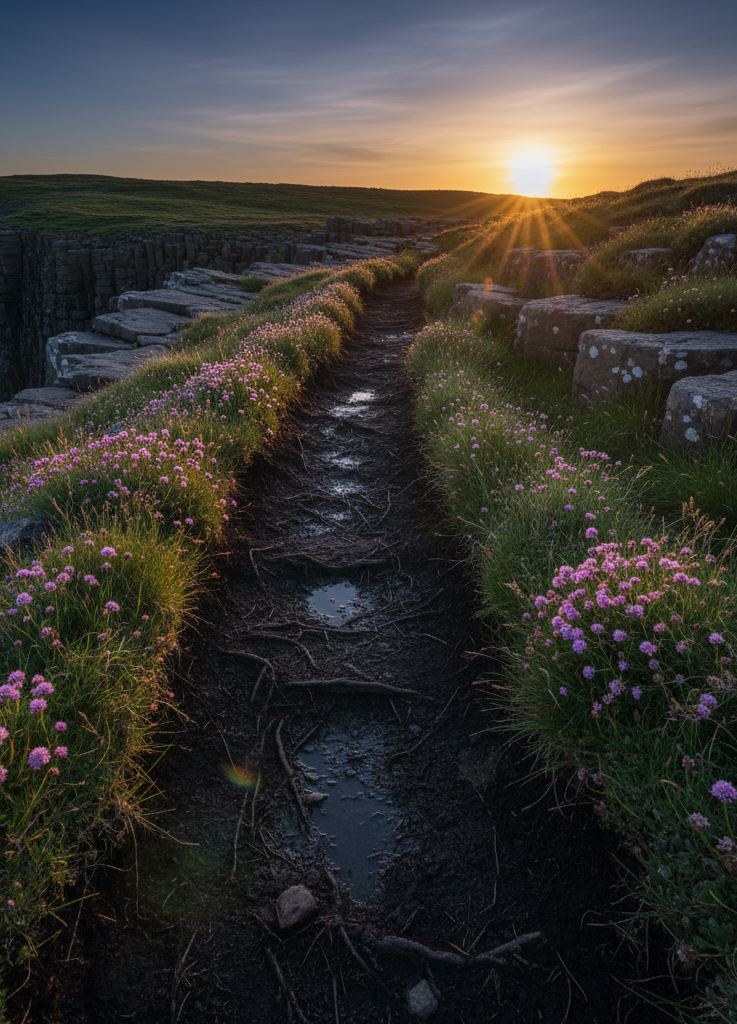
Conditions in the hour are consistent enough to plan clothing around. Air temperature at one in the morning in late June sits around 46 to 50 degrees, wind is usually between 10 and 25 miles an hour and comes at you across open water, and if it rains it does so in short pushes rather than steadily. Rain of some kind falls on something like nineteen days out of thirty here in June. The ground is peat under cropped grass and it does not dry out, so the footing is soft and slick even after four days without weather, and there is no fence, rope or edge marking at any of the seven.
What is reserved, and where the bills come from
Roving Hours places the reservations and nothing else. The two guesthouses, the vehicle, the seven led hours and the land access on the four private headlands are what Roving Hours Bookings LLC actually books for you. The two water crossings, the one to Mykines and the hour under the wall at Vestmanna, are held by the companies licensed to run that passage; the office asks them for seats and they answer, and they charge you directly for the seat if the sea lets them sail at all. No part of the figure on this page covers a seat in the air. Getting yourself to the islands stays yours to arrange, and it will take you two flights from Orlando in either direction.
Not one room, vehicle or boat seat named above belongs to this office. Whichever company is actually working the dates you take is the company whose invoice reaches you, and it reaches you from them rather than through Roving Hours Bookings LLC, which handles no money at any point in this. Send the dates you want held by phone on +1 (407) 629-3157 or in writing to bookings@rovinghours.com, and a written figure for those exact dates comes back inside two to four working days, because the guesthouses on these islands are small and answer by hand. The office is at 1350 N. Orange Avenue, Suite 221, Orlando, FL 32789, in Orange County, Florida. If something on this page has gone out of date, and the sailing conditions and the access fees both change, corrections@rovinghours.com reaches the person who keeps it correct.
Start with the weeks, not the country
This form takes requests every hour of every day, and a person answers within one business day. Nothing here commits you. No figure is charged at this end.