black skins, vine smoke, sauce to the wrist by one
Reserve a calçotada trip in the Camp de Tarragona, late January to early April
Five nights in a stone farmhouse outside Valls in the Alt Camp, on a departure set anywhere between January 24 and April 6, from $3,722 per person on two sharing. Four of those five days are programmed for one block in the middle of the day, when a bundle of vine prunings is lit and twenty five onions a head go into the flame. What the figure holds is a crop that is only the right size for about ten weeks of the year.
Reserve a windowAn answer is written inside one business day by somebody at this end.
A calçot is a white onion that has been planted twice and buried three times, and it is worth eating for about ten weeks of the year. You can reserve a calçotada trip in the Camp de Tarragona for any week inside those ten, from January 24 to April 6: five nights in a stone farmhouse outside Valls, and four days on which the middle of the day is handed over to a fire, a bundle of vine prunings and twenty five onions a head.
The short season is in the plant. A bulb lifted in July goes back into the ground whole in August. Instead of swelling into one head it throws six to ten shoots, and as those shoots come up the grower pulls soil around them two or three times, so the stem lengthens pale and mild under the soil rather than green and sharp above it. Cut at the right moment the white shaft measures 15 to 25 centimeters and the base is under 2.5 centimeters across. Leave it three weeks past that and warmth thickens the base, the outer skins toughen and a flower stem forms in the core.
None of what is described here belongs to Roving Hours Bookings LLC. The rooms, the vehicles, the plots and the grills are other people's property, and the company that runs the four blocks invoices you in its own name once the days are settled. This agency lodges the reservation from 1350 N. Orange Avenue, Suite 221, Orlando, FL 32789 and touches no money at any point in it.
Runs January 24 to April 6.
It opens in the last full week of January, when the white shaft on most plots has reached the 15 to 25 centimeters the growers cut to and the farms that set a long table begin their season, and it shuts when rising temperatures push the base past about 2.5 centimeters across and a flower stem forms in the core, which turns the shoot woody from the middle out.
Both ends slide about ten days on how the fall ran, and a warm February shortens the far end faster than anything shortens the near one, so any date you name after March 20 is quoted against a second farm in the Conca de Barberà, thirty five kilometers inland and 230 meters higher, where the same crop runs ten to fourteen days behind the plain.
A morning or an evening. The programmed block runs from about 10:45 to 15:30, covering the lighting of the fuel, the eight to twelve minutes the onions are actually in the flame, and the long table that follows them.
Everything before a quarter to eleven is yours and nothing at all is arranged after the table breaks up, which in practice means an hour of sitting still and then a walk, because shops in Valls close from 14:00 to 17:00 and then stay open until 20:30.
5 nights, from $3,722 per person.
The meal does not depend on weather and goes ahead under a porch roof in rain, but the crop varies inside the window: shoots cut in the first half of February usually run 18 to 20 centimeters and eat sweet, while a run of warm days in March coarsens the skins and the growers start cutting for weight rather than for a table. Nobody underwrites a crop, and if the plain has gone over early you are moved up to the higher farm and told that is what happened, rather than served the same week under the same name.
- What this office books
- The office reserves the farmhouse rooms, the four programmed blocks, the vehicle and driver for those hours, and the places held at two family tables and one village grill house; it reserves no flight, no car for your mornings and no meal outside the four.
- Who books it
- A person booking this wants to eat the thing in the weeks it is the right size, on the clay it grew in, at a table where most of the people down the far end are related to each other.
- Why somebody picks another window
- If you want this same country warm, with the vines in leaf and dinner outdoors at ten at night, take a September window instead, when the fruit is coming in and there is not an onion in the ground.
- In the figure
- Five nights in a stone farmhouse of five rooms outside Valls, two people to a room; breakfast laid out from 08:00 and left out until you come down; four programmed blocks of 10:45 to 15:30, two of them at family farms where the same people grow, cut and grill; one at a village grill house that puts out four hundred covers on a February Sunday; one spent in a plot and a tying shed while a row is lifted for that afternoon's orders; twenty five onions a head at every table, with the second course of ribs, sausage and white beans off the same coals; the sauce made in front of the group on one of the four days, mortar and all, and as much of it as you can get through; ground transport for the programmed hours, 15 to 40 minutes each way; a Catalan speaking guide who works in English on all four blocks; bib, gloves and a change of shirt if you did not bring one; the operating company's written running order for each block; local room taxes.
- Not in the figure
- The flight out of Orlando and back, which you buy for yourself, $735 to $1,420 round trip in February and higher in the week before Easter; the train or road leg from the arrival airport down into the Alt Camp, $28 to $95 a person each way; a car for the mornings, $34 to $58 a day plus fuel and tolls; every meal that is not one of the four blocks, $16 to $48 a head; anything you drink away from those four tables; entry on the town's own calçot day on the last Sunday of January, ticketed by the town, $9 to $22; entry to either of the two Cistercian monasteries within 30 kilometers of the farmhouse, $9 to $13 each; the regional visitor levy collected at the property, about $1.10 to $2.40 a person a night; laundry at the farmhouse, $15 a load; a room to yourself if you are not sharing, $57 a night; gratuities, which nobody on this trip will ask you for.
- Who this window will not suit
- This is four long lunches inside five days and most of the block is spent sitting down. You eat the first course standing with your hands, the sauce goes to the wrist and down whatever you are wearing under the bib, and the smell of burnt onion skin stays in your hair until you wash it. Anyone who does not eat garlic, almonds, hazelnuts, lamb or sausage will be left with bread and beans, because there is no second menu at a table like this and asking for one rearranges the day for thirty people. If a midday that runs four hours and ends with everybody still talking reads to you as time taken away, this is the wrong window and no amount of scheduling will fix it.
A starting figure for two people sharing one room. Pricing the exact window you pick runs two to four working days, because the company working those dates answers first. No air ticket is ever folded in.
The ten weeks the crop allows
Growers around Valls start cutting in late November, but the first shoots of a season are thin, and almost everything out of the ground before Christmas goes to households buying by the bundle. Tables a visitor can sit at are a January business. Farms that set up a grill and thirty chairs open in the last full week of the month, which is also the weekend the town gives over to the crop, and from then until the plots go over there is a fire somewhere in the Alt Camp every Saturday and Sunday.
The office sells January 24 to April 6 and refuses dates outside it in both directions. December is not sold because the shaft is not there yet and the growers cut for wholesale. April past the first week is not sold because it stops being the same food: the base is thicker than a thumb, the skins have gone leathery, and what arrives at the table is a leek that has been on a fire.
Both edges move by roughly ten days on the previous fall. Wet weather in October gives a strong shoot and an early start. A warm February shortens the far edge much faster, which is why any date after March 20 is priced against a second farm over the low pass in the Conca de Barberà, 230 meters higher, where the same variety runs a fortnight behind the plain.
The block that begins at a quarter to eleven
It starts with fuel. Vine prunings from the winter cut, tied into a bundle about the size of a bale, are dropped into a length of old iron or onto a bed of stones and lit, and they burn hot and go fast, one bundle down in about ten minutes. The onions go into the flame and not into the coals. They are laid across a grid at an angle, packed close, and they are finished when the outside is completely black and the inside has steamed in its own skins, eight to twelve minutes depending on the thick end. Then they are lifted, folded into paper or covered with a tile to sweat, and carried to the table still wrapped.
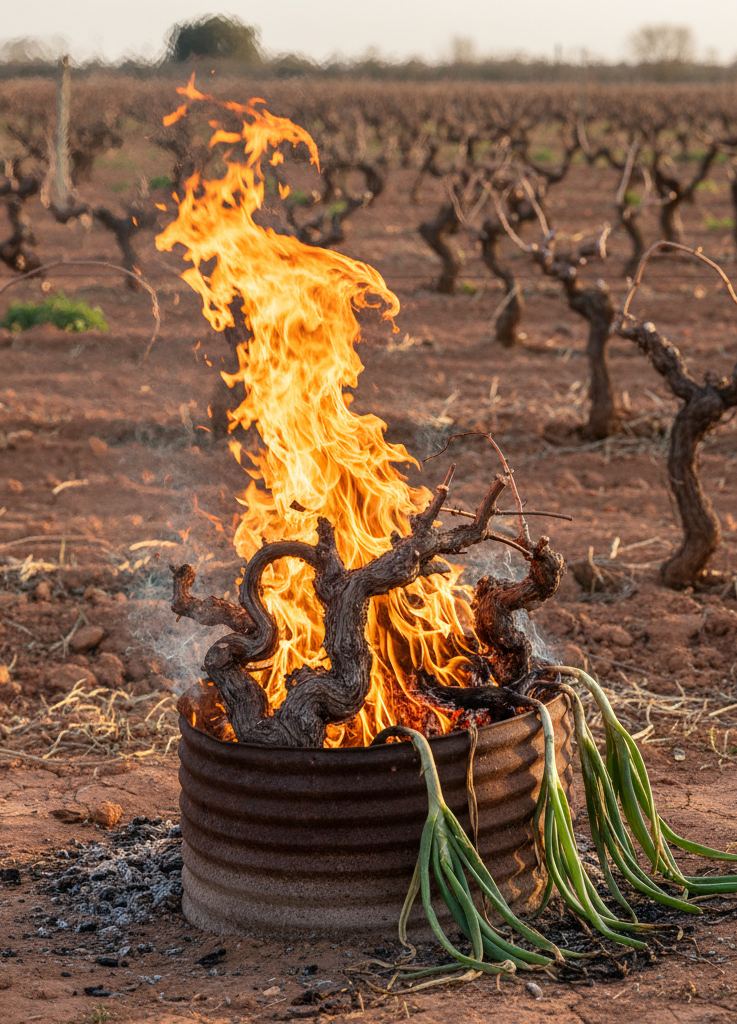
The first course is eaten standing. You take a black shoot by the green top, strip the outer layers off in one pull with your other hand, drop the white into the sauce as far as your fingers, lift it clear, tip your head back and lower it in from above. The sauce is a mortar job and it takes about forty minutes: dried peppers soaked and scraped out, toasted almonds and hazelnuts, garlic, roast tomato, bread, vinegar, oil. Twenty five a head is the standard bundle and most people are beaten somewhere around twenty.
Then everybody sits down and the same coals take ribs, a coiled sausage and white beans, and the afternoon goes long. Wine comes out of a glass vessel with a spout, held above the mouth without touching it, which every visitor attempts and about half manage by the second day. The table breaks up between three and half past, and after that nothing whatever is programmed.
- Last week of January
- first farm tables, shoots 15 to 18 centimeters, 4 degrees on the plain at night
- Early February
- the steady fortnight, vines still pruned, fuel for your fire cut in the next row
- Mid February
- sun up 07:55, off the plain 18:23, tables running every weekend
- Late February
- field edges in flower, shaft at its widest inside the 2.5 centimeter limit
- Early March
- pruning stacked and drying, wind off the hills, the odd afternoon at 20 degrees
- Mid March
- the plain goes over in a warm year, the higher farms ten days behind it
- Late March
- clocks forward, table in full sun, only the Conca de Barberà plots quoted
- First week of April
- base thick, flower stem in the core, window shut until the next fall
The plain, and the hills that run a fortnight behind it
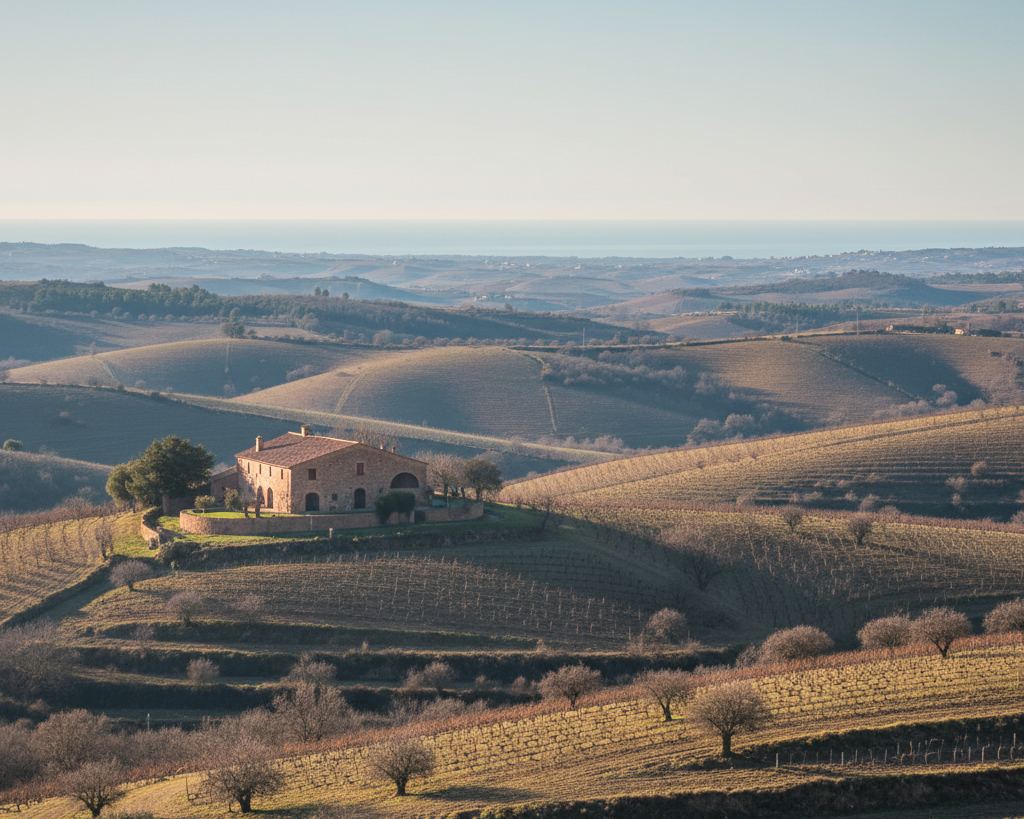
Valls sits at 215 meters on red clay, 20 kilometers in from the water at Tarragona, with the Francolí running down past it. The plain around the town is planted in hazels, vines and onions at the same time, in plots small enough that a family works its own without hired hands. That mixture is not decoration. The hazel goes into the sauce, the vine goes into the fire, the onion is the reason you came, and all three come off ground you can see from the same wall.
Behind the town the land climbs. The Conca de Barberà, over the pass to the northwest, lies between 350 and 500 meters, and that height reads as about two weeks in the crop. Most years it matters to nobody. In a March running four degrees over average it is the difference between eating a calçot and eating something that used to be one, and that is why the higher farm goes into a late quote at the start rather than arriving afterward as a rescue.
Conditions across the window are mild and not warm. Nights on the plain hold at 3 to 6 degrees Celsius through February, the middle of the day gets to 14 to 16 in the sun and drops several degrees the moment you step behind a wall, and rain arrives short and heavy rather than settling in for a day. The clocks stand about an hour ahead of the sun here, so solar midday falls near 13:10, which is why a block starting at 10:45 is a normal late morning and the two o'clock sitting is simply lunch.
Late January against the last week of March
The two ends of this window are not the same trip, and it is worth deciding which one you are describing before the dates are set.
In the last week of January and through the first half of February the plain is cold, the vines are still being cut, and the fuel is being made in the row beside you while you stand there. Tables are indoors or under a roof, and the shoot is on the narrow side of the specification and eats sweet for it. The qualifier is that the town's own weekend falls on the last Sunday in January and brings several thousand people into one square, which makes those two days a poor choice for anyone who wants a family table with twelve at it.
By the last week of March the pruning is stacked, the vines are in bud, the table is outside, everybody is squinting, and the shaft has thickened toward the top of the range. Both ends are worth doing. They are not interchangeable, and the week that comes back from the growers is a different week depending on which one you ask for.
Putting a number on the fortnight you name takes two to four working days here, because a five room farmhouse and two families who grow their own crop do not answer inside an afternoon, and a figure confirmed by only one of the three is not worth sending you.
Send the fortnight is in view, how many people are going, and whether anyone at the table does not eat nuts. Use the form below, the telephone on +1 (407) 629-3157, or write to bookings@rovinghours.com. Anything wrong on a quote already sent is corrected through corrections@rovinghours.com.
Roving Hours Bookings LLC is an independent booking agency in Orlando, Orange, Florida. Not one of the five rooms, neither vehicle, no grill and no plot in any of this is company property. The company running those four days bills you in its own name, on paper with its own address at the top of it, under the licences it holds for the purpose. You buy the flight out of Orlando yourself, and nothing that flies is sold or ticketed by this agency.
Start with the weeks, not the country
This form takes requests every hour of every day, and a person answers within one business day. Nothing here commits you. No figure is charged at this end.